A Token China Shock
Revisiting AI Thermodynamics, a divergence in credit, and the real story on profits

Last week, I spent some time on what I got wrong. Let’s talk about some things I may have gotten right.
First, there is a growing awareness that AI economics simply don’t work as discussed in xAirSupply. This is predictably causing two separate actions:
Users are increasingly shifting to lower-cost Chinese models — with the national security implications underpriced but difficult to underwrite.
US AI companies are retreating behind protectionist and anti-competitive measures, hoping to extract premium pricing for leading-edge models while shifting more casual users to lower-cost alternatives.
The past week has seen articles proliferating, citing the growing usage of “near-frontier” Chinese models by users recognizing that for the vast majority of tasks, “pretty smart” is good enough:
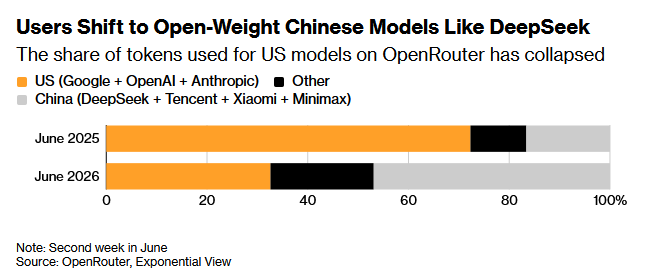
There are two sources of China’s cost advantage. First, “fast followers” have always benefited from rapidly changing technology, as the performance advantage of first movers comes at an extraordinary cost, while fast followers can benefit from the diffusion of technology and techniques. Many of the Chinese breakthroughs involve using LESS hardware to accomplish the same task. While US proprietary labs doubled down on capital-intensive scaling bets—collectively raising tens of billions in a high-valuation arms race dependent on high API margins—Chinese competitors quietly weaponized open-source efficiency.
The narrative that Chinese models are simply inferior copies completely collapsed. By optimizing training stability rather than relying on brute-force compute infrastructure, labs like DeepSeek and tech giants like Xiaomi have triggered a permanent, deflationary price war.
The 99% Compression: DeepSeek’s R1 and Xiaomi’s MiMo-V2.5 are undercutting major Western API providers by 90% to 99%. For example, processing cached input tokens has dropped to fractions of a cent per million, effectively resetting the cost floor for enterprise automation.
The Agentic Loop Vulnerability: This pricing divergence matters because high-volume enterprise workloads and multi-step agentic workflows are incredibly token-hungry. When a complex workflow requires an agent to repeatedly query, plan, and call tools, premium US tier pricing becomes a prohibitive tax. Moving to high-performing Chinese alternatives isn’t just an optimization; for many startups and enterprises, it’s a structural runway extension.
The Funding Paradox: This creates a dangerous trap for Western foundational model providers. Their stratospheric private valuations assume massive premium enterprise margins to justify their infrastructure capex. If the market commoditizes into an open-source “free or near-free” paradigm driven by Chinese state-subsidized or hyper-efficient stacks, the economics of proprietary scaling break completely.
This is exactly the China playbook for solar, batteries, and increasingly autos. Nuclear power plants are not far behind. This leads to the second factor: China’s propensity to overbuild means its electricity generation per capita is surging. Sometime in the next few years, it should cross the US level per capita:
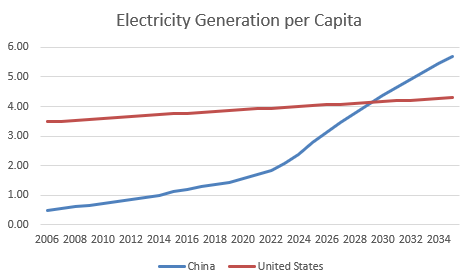
Assuming this plays out, it points to a new business model for China as exports of manufactured goods hits limits; perhaps we are about to see the rise of the “Token-state,” a play on Petro States, where China exports surplus energy in the form of AI work. If China’s electricity generation per capita continues its current trajectory, it may eventually converge with or exceed U.S. levels. At that point, China’s export model can evolve from shipping embodied energy as solar panels, batteries, steel, autos, and chemicals to shipping embodied intelligence as tokens.
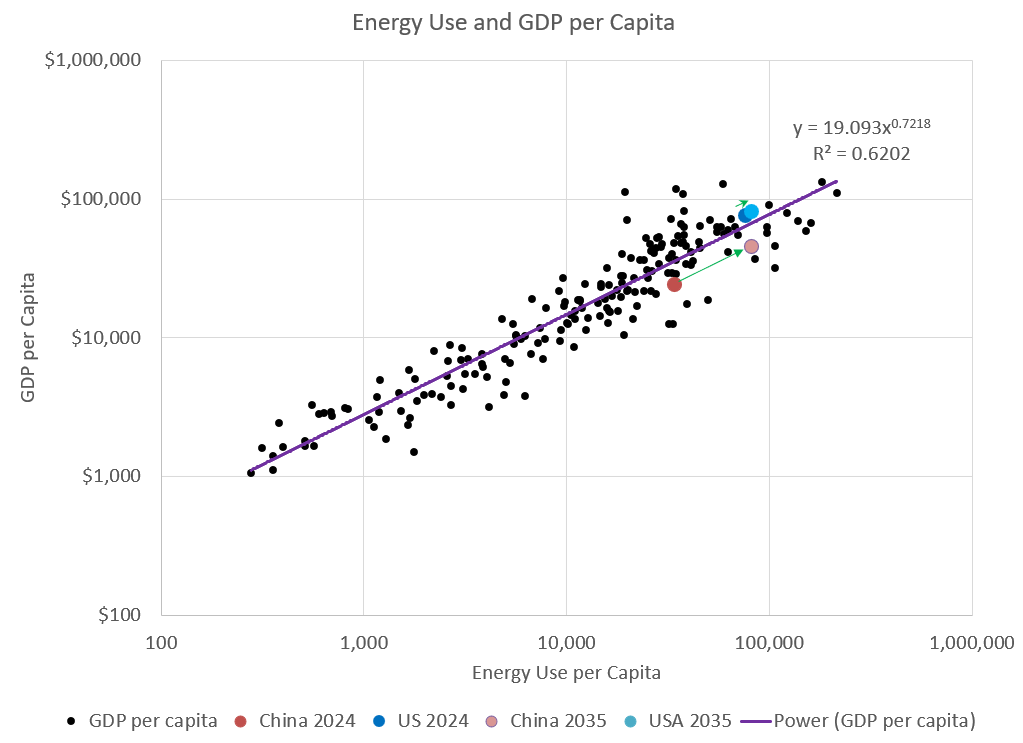
The irony is not lost on me that we’re just now digesting the China manufacturing shock; wouldn’t it be a shame if AI went the same way?
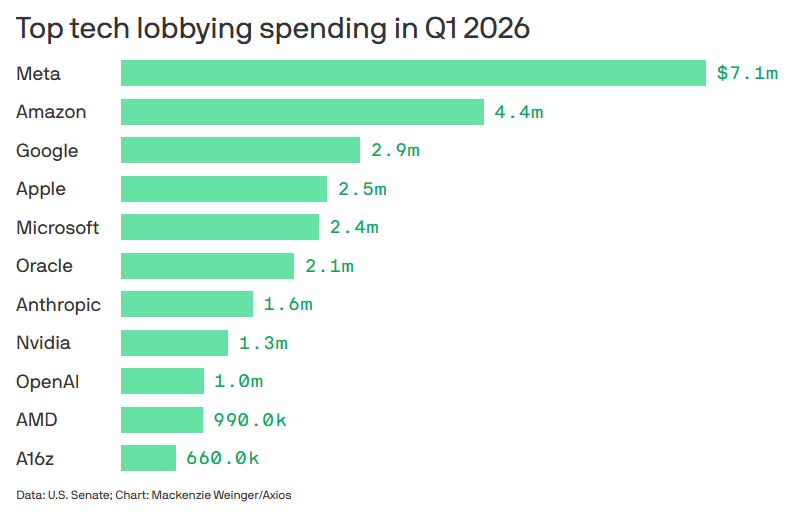
We can’t let that happen, which leads us to protectionism. I’m sure you’ve seen the headlines. Both OpenAI and Anthropic have radically increased their lobbying spend:
Predictably, this is resulting in government intervention. In Illinois, OpenAI is lobbying for the passage of SB3444, the Artificial Intelligence Safety Act, which indemnifies “frontier” AI firms from critical harms caused by their models, provided they either (1) agree to regulation by the EU or (2) enters into an agreement with the Federal government:
Creates the Artificial Intelligence Safety Act. Provides that a developer of a frontier artificial intelligence model shall not be held liable for critical harms caused by the frontier model if the developer did not intentionally or recklessly cause the critical harms and the developer publishes a safety and security protocol and transparency report on its website. Provides that a developer shall be deemed to have complied with these requirements if the developer: (1) agrees to be bound by safety and security requirements adopted by the European Union; or (2) enters into an agreement with an agency of the federal government that satisfies specified requirements. Sets forth requirements for safety and security protocols and transparency reports. Provides that the Act shall no longer apply if the federal government enacts a law or adopts regulations that establish overlapping requirements for developers of frontier models.
And surprise, surprise, Anthropic and OpenAI have entered into an agreement with an agency of the federal government:


The striking feature of SB3444 is not that OpenAI and Anthropic suddenly entered into federal agreements after the bill was introduced. They had already done so. The striking feature is that the bill appears to convert that preexisting federal-safety relationship into a potential safe-harbor architecture. Now, of course, both companies claim to be dragged into these deals kicking and screaming:
Brer Rabbit pleaded, “Do what you want, but please don’t throw me into the Briar Patch!”
Which brings us to the bigger think piece:
