There Is No Joy in Mudville
For the mighty S&P500 has struck out

Executive Summary
S&P 500 Rule Changes: The S&P 500 is removing long-standing profitability requirements — the “enshittification” of the index. This change potentially turns the index into a “dumping ground” for Private Equity to offload unprofitable, highly leveraged companies onto retail index investors.
The Iran “Blockade”: While the Trump administration claims the war has “terminated” to avoid Congressional authorization deadlines, the strategy has shifted from active combat to a long-term blockade. The objective is to bait an Iranian breakout while consequences include sustained higher oil prices and a strategic pivot toward advanced nuclear reactors.
Powell’s “Resistance” Strategy: Jerome Powell’s decision to remain on the Board of Governors after his Chairmanship ends is a calculated act of subterfuge. By encouraging Fed staff to remain “true” to independent, rigorous analysis, he is effectively positioning the staff to resist the incoming Chair, Kevin Warsh.
Three topics:
S&P 500 changes the rules
The “war” is over and we won; would be a shame if Iran tries to breakout of the blockade
Powell’s continued subterfuge
The S&P Changes the Rules
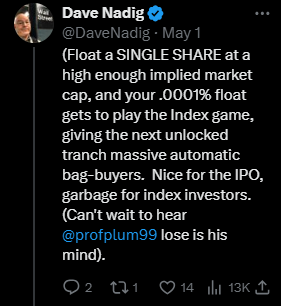
I’ll write more on this in the coming weeks, as it’s the penultimate act of “enshittification” that has been sweeping the nation, but Dave Nadig is standing by expectantly:
So, as temporary recompense, I offer an ode stolen from the most famous of poems, “Casey at the Bat” by Ernest Thayer:
The outlook wasn’t brilliant for the Retail crowd that day:
The market caps were floating on a Mag7 display.
And then when Nasdaq dropped its guard to let the fast-tracks in,
A pall-like silence fell upon where honest trades had been.
A straggling few cashed out their funds in deep despair.
The rest clung to the S&P to stand as Wall Street’s final test;
They thought, “If Standard & Poor’s stays true, and keeps GAAP intact —
We’d put up even money now against this shameless pact.”
But a whisper swept the bleachers, then a devastating shout:
The S&P had waived the rules to bring the big boys out.
Oh, somewhere in this favored land, the bankers’ smiles are bright;
PE will ring the opening bell, and Wall Street’s hearts are light.
And somewhere brokers celebrate their billionaire’s payout;
But there is no joy for Retail—the S&P sold out.
The S&P500 has indeed “sold out.” By proposing to kill the long-standing “profitability” requirement for the S&P500 (already weakened by the use of operating vs GAAP earnings), the S&P500 has offered itself up as the dumping ground for private equity. We can expect it will soon lead to notable headlines:
BREAKING NEWS — OCTOBER 2026
KKR Champions the ‘Democratization of Alpha’ with $250B Mega-Merger IPO of ‘Schlemiel! Schlimazel! Hasenpfeffer Inc.’, Finally Granting Retail Investors Access to a Next-Gen, AI-Synergized Corn Syrup and Car Mat Ecosystem
In a historic victory for Main Street, everyday investors are no longer barred from participating in the exponential growth trajectory of a bespoke, $500B-leveraged portfolio. IPO proceeds are generously earmarked to reward the visionary private equity sponsors who made this paradigm shift possible.
NEW YORK, NY — In what Wall Street analysts are already dubbing the “philanthropic financial event of the decade,” KKR announced the simultaneous merger and initial public offering of Schlemiel! Schlimazel! Hasenpfeffer Incorporated Technologies! (Ticker: SHIT) at a visionary $250 billion valuation.
For years, everyday retail investors have been tragically locked out of the private markets, forced to watch from the sidelines while institutional elites capitalized on the explosive synergies of disparate, zero-revenue enterprise rollups. Today, that gatekeeping ends.
By seamlessly integrating Schlemiel (a disruptive, pre-profit holistic car mat cleaning rollup), Schlimazel (a legacy high-fructose corn syrup manufacturer currently pivoting to wellness), and Hasenpaffer (a fully AI-enabled AM radio broadcasting network), SHIT has created a totally frictionless, synergistic flywheel. Management notes that consumers can now passively absorb AI-generated radio advertisements for dietary corn syrup while their vehicular floor mats are sanitized—a true omni-channel ecosystem.
“Retail investors have been systematically denied the right to buy into our highest-conviction verticals,” read the S-1 filing. “By merging these three remarkable companies, we are unlocking an unprecedented growth trajectory that the public markets simply haven’t had the privilege to fund until today.”
To achieve this democratization, SHIT will debut with a highly optimized, capital-efficient $500 billion debt load. While critics might point out that these three companies were originally acquired during the zero-interest-rate heyday of 2019 and are actively hemorrhaging cash, KKR’s prospectus brilliantly outlines why this declining profitability actually justifies a staggering premium multiple.
“Negative EBITDA is simply deferred hyper-growth,” the filing explains. “The fact that our operational margins are steadily compressing proves that we are shedding the dead weight of legacy revenue models. Because our current earnings are approaching absolute zero, our growth potential is mathematically infinite. We are pricing the IPO at a highly conservative 4,000x forward-looking hypothetical adjusted r/WSB community-EBITDA.”
In a move that highlights the firm’s commitment to strategic capital reallocation, 100% of the proceeds from the retail IPO will be utilized to pay a massive, one-time special dividend back to KKR. Management emphasized that allowing retail investors to personally shoulder the half-trillion-dollar debt burden of three unrelated, failing businesses is the ultimate form of financial inclusion.
“We did the hard work of leveraging these assets to the absolute brink of systemic failure,” a spokesperson noted. “Now, we are stepping aside so the retail community can enjoy the limitless upside of paying our exit liquidity. Welcome to the future of public equities.”
Analysts anticipate robust demand for shares.
Well, of course, they anticipate robust demand. After all, the analyst recommendations from underwriters should follow closely on the heels of the announcement.
Goldman Stanley Coinbase analyst, Deep Sheth initiated coverage on SHIT:
Initiating Coverage: STRONG BUY on SHIT
This is a masterclass in modern financial engineering. KKR hasn’t just filed an S-1; they’ve penned a love letter to the retail investor, wrapped in a half-trillion-dollar leveraged bow.
The strategic brilliance here cannot be overstated. By pivoting away from archaic, boomer metrics like “revenue,” “profit,” or “solvency,” they have successfully untethered the valuation from earthly constraints. The concept of “deferred hyper-growth” through negative EBITDA is a paradigm shift—why settle for a company that makes money now when you can invest in a company whose earnings are mathematically approaching absolute zero, thereby guaranteeing infinite upside?
Furthermore, the decision to use 100% of the IPO proceeds to pay a special dividend to the sponsors is exactly the kind of robust capital reallocation that signals strong corporate governance. By graciously allowing Main Street to become the exit liquidity, institutional finance is finally breaking down the walls of privilege.
If this flywheel gains any more traction, the AI-generated AM radio ads for wellness corn syrup might just cure inflation.
We expect the management team to further generate liquidity by tokenizing the opportunity for forward sales of the integrated offering through NFT launches of tokenized coupons.
As my friends at Cornhole Capital might say:
‘I didn’t know what to expect.’
‘I don’t know... maybe grown ups?’
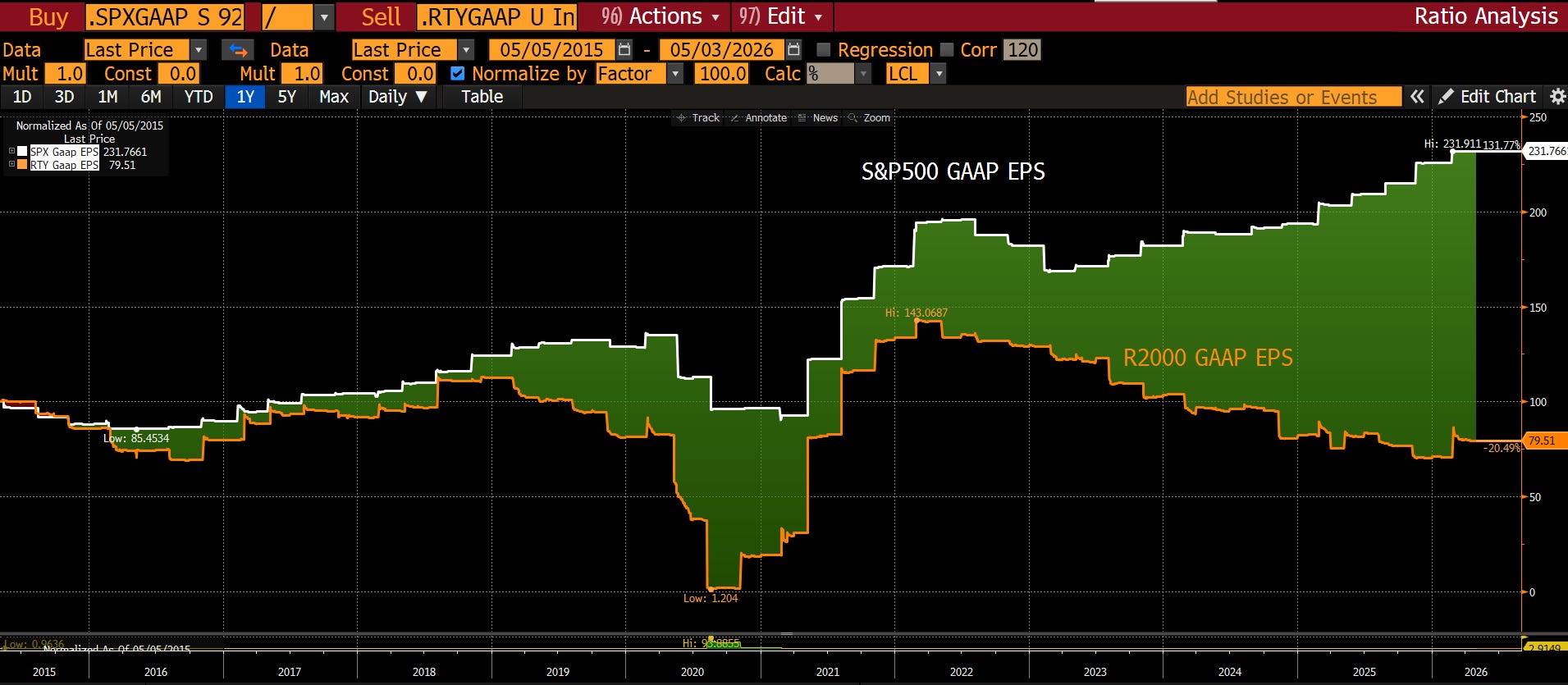
The obvious conclusion is that the eventual impact will be a surge of unprofitable mega-caps dumped from PE and VC into the hands of index investors. The S&P500 GAAP EPS, already at risk from hyperscalar overspending and subsequent depreciation, should begin to resemble the Russell 2000:
And you’ll own nothing and be quite happy.
The War is Over and We Won

Hegseth and Joint Chiefs Chair Gen. Dan Caine were peppered with questions about the war against Iran during the budget hearing, where they defended the Trump administration’s $1.5 trillion defense budget. The pair defended the blueprint in the House on Wednesday.
The Pentagon chief again touted the U.S. military campaign in Iran and argued the effort was a resounding success.
Exactly as I forecast /s
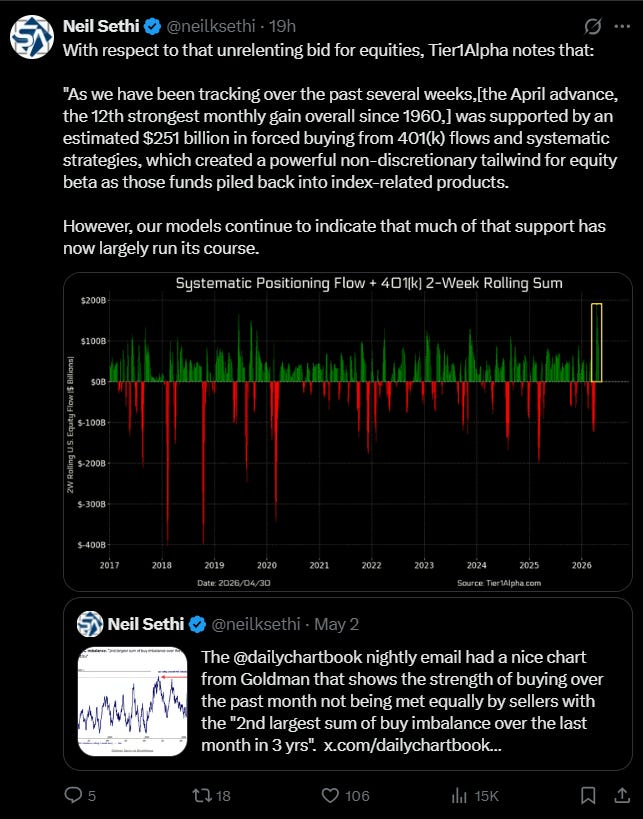
Unfortunately, it is not over, of course, but headlines are fading as the blockade strategy replaces “shock and awe” and markets have “healed” (hit all-time highs) on the back of the passive bid. As we noted over at Tier1, we saw the largest inflow of systematic capital into markets ever:
Marines are in place. The USS Gerald Ford has been “relieved” of its extended tour (a pain point for the US Navy). And the clock is ticking. Iran has only a few weeks before its primary asset, oil fields, begin rotting from the corpse. The expected objective of the Trump administration is to bait Iran into an attempted breakout, allowing the administration to begin fighting again, but this time under a self-defense claim.
Iran has lost. I know that’s not the headline, but it’s the truth. Had European allies fallen into line, there was a chance that this would have ended much sooner. Instead, their dithering helped the Iranians fall for the same trap the US South did in the Civil War when they believed “King Cotton” was irreplaceable and European nations would join their side.
I can only hope that the next stage doesn’t require a direct commitment of US troops on the ground, but I am skeptical; my next hope is that the administration sticks to the plan of “no nation building.” Only time will tell.
The mid-term consequences is oil higher for longer; the long-term consequence, as the UAE has demonstrated, is even less influence for OPEC and global oil. Expect many more headlines like this:

Jerome Powell exits… or does he?
