Maid in Japan
Cleanup in rates, Aisle 30

An Apology
One test of expertise is whether you can explain your subject to someone standing outside the field. Strip away the industry jargon and the idea should still hold up. Last week I failed that test. Several of you told me so, politely and otherwise.
Part of the reason is worth explaining. Leveraged ETFs themselves are familiar ground -- I have traded and exploited their mechanics for over a decade. What sits at the outer limit of my understanding, and frankly of anyone’s, is what their flows do to the underlying securities. That is the breakthrough work the team at Tier1 Alpha Research and I are pursuing, and last week you were watching it happen in real time. When I write about topics I have lived with for decades, the plain-English version comes first and the math follows. Last week the math came first, because the plain-English version did not exist yet.
So before moving on, let me give you the short version of what we actually found at Tier1.
What “A Semi-Theory of Almost Everything” said, in plain English
Semiconductor stocks nearly doubled last quarter, then fell hard. We wanted to know whether the ETF products built on top of those stocks helped cause both moves.
Leveraged ETFs are machines. A fund promising three times the daily return of the semiconductor index has to buy more exposure when the index rises and sell when it falls. Every day. No judgment involved.
What matters more is who owns the machines. Owners of the older bull funds historically sold as prices rose -- taking profits, which leans against the trend and acts as a brake in a predictable “vol decay harvesting” strategy. Owners of the funds launched this year did the opposite, adding as prices rose. Owners of the bear funds doubled down as they lost, the way a gambler doubles his bet after every losing hand.
In April, the behavior of SOXL’s owners shifted measurably under the aggregate pressure of new holders. The profit-taking weakened. The brake got softer at the same moment dozens of new amplifiers came online, including a wave of single-stock levered wrappers. With only one exception, Micron’s 2x levered ETF, these mattered little to the equation due to their small size. The more interesting feature of these funds is the desperation in ETF management that they demonstrated — we are throwing half-cooked spaghetti at the wall to see what sticks.
One new sector fund, DRAM, broke that mold with large inflows and bought steadily regardless of what the market did that day -- slightly more on down days, if anything. That looks like money arriving on a schedule, indifferent to price — portfolio allocation rather than stock selection. And, alongside South Korean levered funds, these indifferent-to-price flows basically broke the South Korean stock exchange.
We built a simulation calibrated only on behavior before April. Changing nothing except the mix of owner types reproduced the volatility shift that followed. The same market plumbing produced calm AND chaos with the only change in who was buying. This is exactly what the inelastic market hypothesis would suggest.
This week, the same idea at a larger scale. Let’s talk about interest rates.
“When the music stops, in terms of liquidity, things will be complicated. But as long as the music is playing, you've got to get up and dance.” — Chuck Prince, 2007
Begin with the children’s game. In musical chairs, nobody decides who ends up seated. The music plays, the players circle, the music stops, and the outcome belongs to the scramble. That much is genuinely left to the market. Everything else about the game is arranged. Someone set out the chairs and decided how many. Someone chose the players. Someone picked the music — a scramble set to rock is a different game than one set to soothing Bach. And someone holds the remote wired to the play button, though the switch works with lags that are long, variable, and unknown even to the hand on the button.
That is the relationship between central banks and long-term interest rates. The new Fed chairman’s doctrine holds that markets should set rates, and as a description of the final scramble it is true: nobody at the Fed decides where the 30-year bond clears. But the doctrine flatters the game. For fifteen years central banks arranged the chairs — buying bonds by the trillion removes seats; letting them run off adds them back. Regulation picks players, deciding who must sit at this table at all. And Japan chose a generation of near-silent music, which pushed its biggest players into everyone else’s rooms. A central banker who says the market sets rates is the host insisting the seating arrangement was spontaneous. And boy am I confident that Kevin is better at hosting contrived dinner parties than he is at setting rate policy.
Keep the game in mind, because the chairs are being rearranged and the guest list has been restructured.
Long-term government bonds across the developed world are selling off together — prices falling, yields rising — and almost every explanation on the news is about local conditions. In the United States it’s the deficit, the Treasury’s borrowing calendar, and lately the new Fed chairman’s refusal to hold the market’s hand despite his history of personal advancement by taking hands. In Britain it’s fiscal credibility. In Germany, rearmament. In France, politics. Each story is plausible where it lives, but none of them explains the one fact that should dominate the analysis: the markets are moving together.
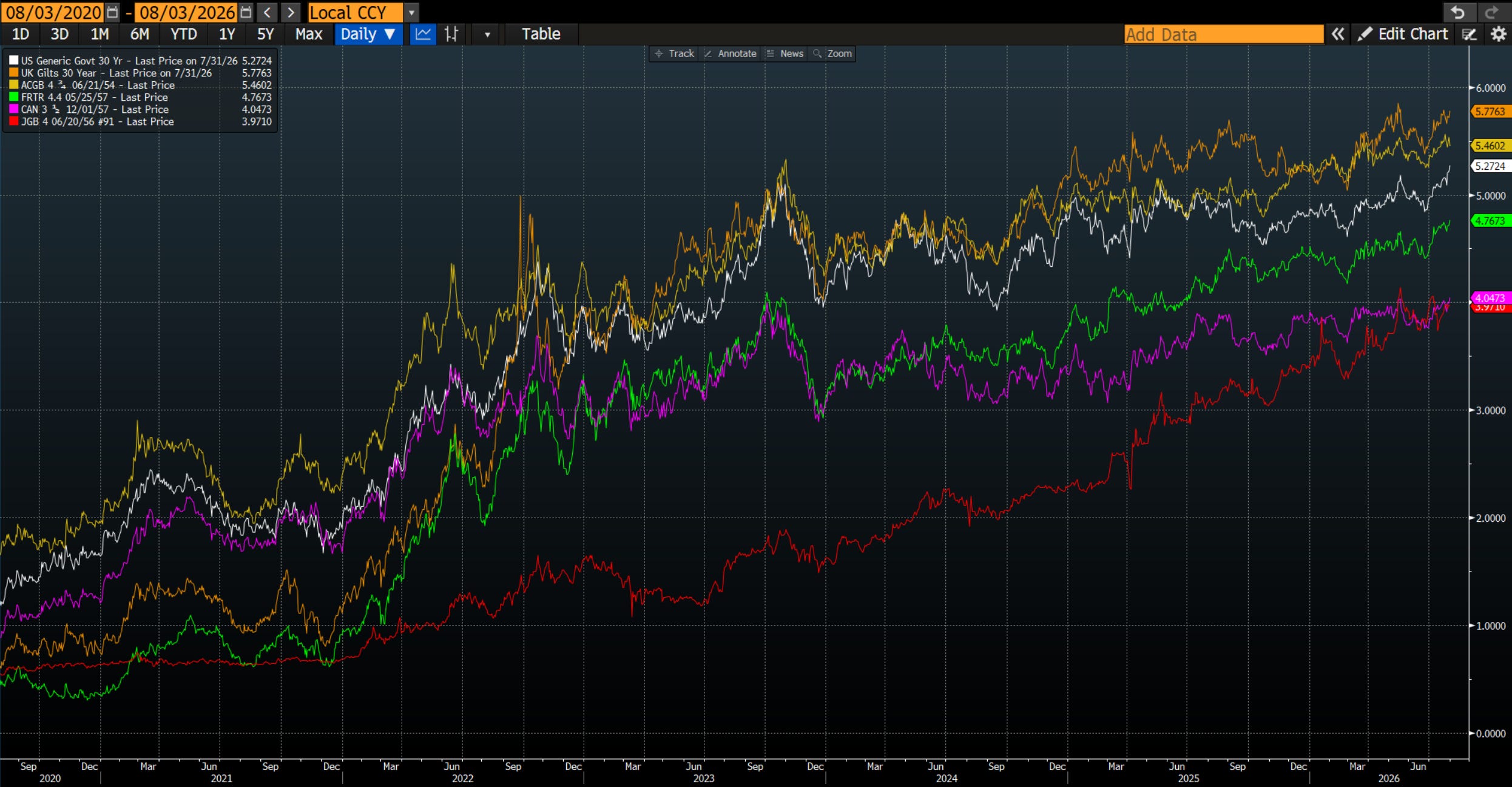
Consider the past few weeks. Germany’s 10-year bund reached its highest yield since 2011. Japan’s 10-year JGB reached its highest since 1996, and its 30-year set a record. Britain’s 10- and 30-year gilts touched their highest levels since 2008 and 1998. Widen the lens to the season, and the count reaches five countries. The 30-year US Treasury has closed above 5% thirty-five times this year, the most since 2007, and finished July at 5.27%, two days after the Fed held rates. The Australian 10-year crossed 5% for the first time since 2011. And the 30-year JGB, the bond that spent a generation as the world’s designated zero, traded through 4% in late July.
That synchronization implies a large common component. The question is which forces created it — and which channels amplified it.
These countries do not share a story. The United States is spending prodigiously on AI and may be accelerating; Japan is old and slow-growing. Germany entered the year with a much stronger fiscal position than France, Britain, the United States, or Japan; Britain and France carry live questions about fiscal credibility; Australia exports commodities to China. What they share is narrower and more important: open bond markets funded from the same global pool of long-term capital. Local conditions explain the size of each country’s move. A change in the shared buyer base helps explain why the moves came together.
The common amplifier is the buyer base. For much of the past two decades, long-bond markets relied on two buyers whose decisions were not driven solely by return. Central banks bought for policy reasons. Japanese life insurers bought to match yen liabilities. Both are stepping back at once. That does not tell us where long-term rates ultimately settle. Growth, inflation, fiscal risk, regulation, and the supply of competing assets all matter. What the withdrawals change is the seating chart. We can hear the music and see some of the players beginning to move — central banks returning long bonds to private hands, Japanese institutions shifting from foreign seats toward domestic ones. But we do not know when the music will stop, who will be left standing, or who will occupy each seat.
The first withdrawal of Central Banks is well covered, although I would emphasize it’s not universal — many central banks continue to intervene. The focus in this essay is the second, and more broadly leading to a follow-on essay focused on private sector implications, likely in two weeks.
The Japanese insurer bid was among the largest sources of cross-border, liability-driven demand. It bought bonds to match long-dated promises, not simply to maximize return. That marginal bid is beginning to turn home, and the market is pricing the turn. The direction is documented while the magnitude remains to be measured. What replaces these buyers in the United States is a different question, for the companion essay.
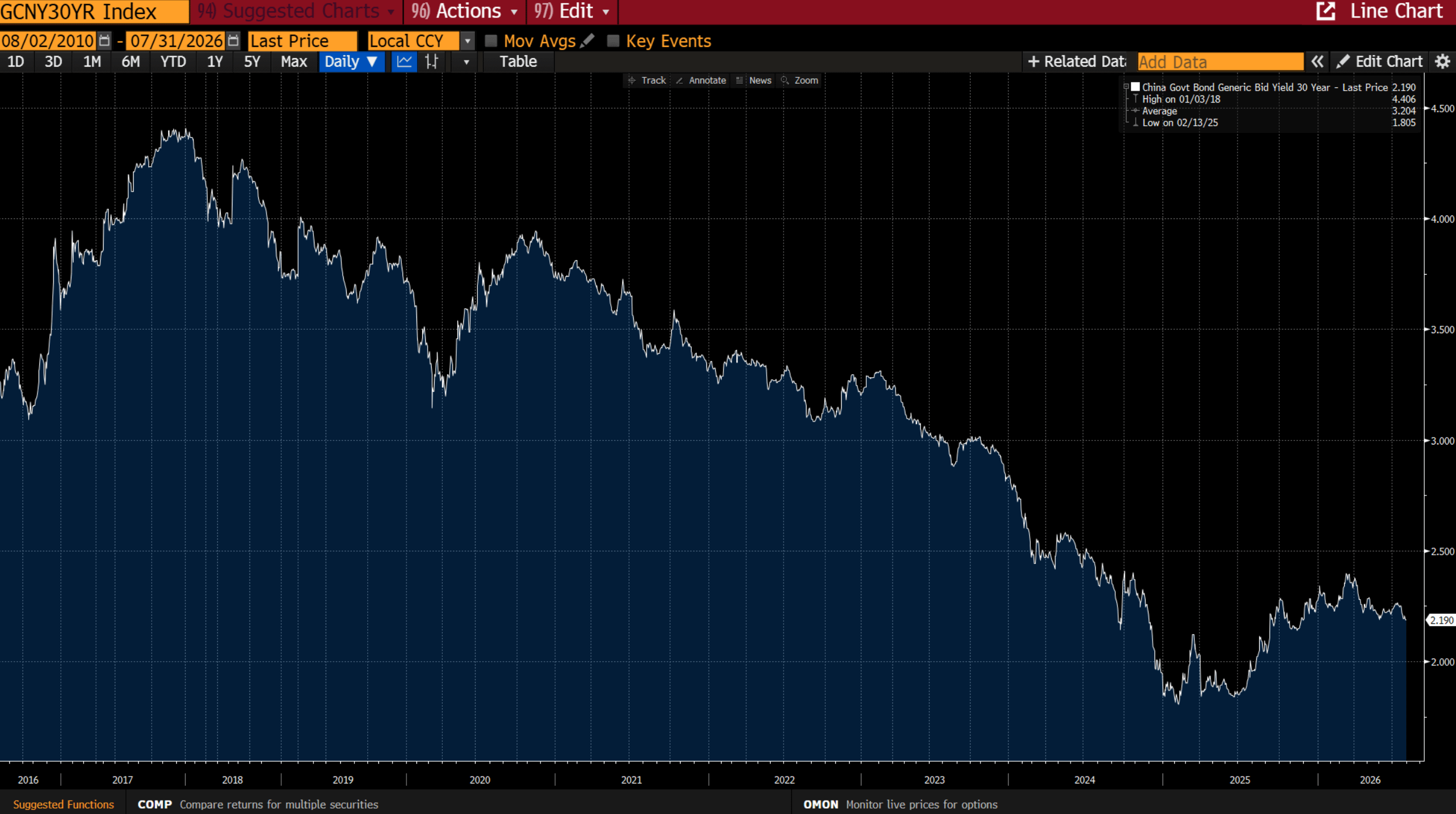
The boundary case is China, whose 30-year bond trades at 2.19%, inside a range of less than half a percentage point all year, drifting lower while the rest of the world reprices. A market only partially open to foreign capital, running its own deflation, did not participate. That is consistent with a flow channel as well… just a different set of flows. Another subject to return to.
The trade that built the long end
A Japanese life insurer carries an average liability cost of roughly 2% — the return its old promises require. During the decade of yield-curve control, the 10-year JGB yielded roughly zero. So the money went abroad — into Treasuries, bunds, gilts, and Australian bonds — until Japan became the largest foreign holder of US Treasuries, at roughly $1.1 trillion by Treasury’s count. That count lumps every Japanese sector and maturity together and tracks custodians rather than owners, so it is a blunt insight on the biggest single foreign pile in the data.
Why would one buyer matter so much in markets this large? Because prices are set by the marginal buyer — the investor who shows up for the next bond, not the ones holding the last decade’s. A market can have a deep, stable base of holders and still reprice sharply if a large, reliable bidder for the newly issued bonds steps away. And the 10-to-30-year Treasury market has a narrower set of natural buyers than shorter maturities. Pensions and insurers want long bonds because they match long obligations. Hedge funds often hold them with borrowed money. Japanese institutions were among the largest foreign buyers.
The question is not “why are yields rising?” — ask that, and you get the parade of local stories. The question is what changed for this buyer. The answer has two parts: one misunderstood, one ignored.
