It’s Time to Complicate
Why the next decade of my work requires a different kind of firm

For five years, I have worked at a firm called Simplify. The irony has never been lost on me.
Einstein said that everything should be made as simple as possible, but not simpler. My entire research program argues that markets have violated the second clause. The migration of trillions of dollars from discretionary judgment into mechanical, price-insensitive strategies has simplified the act of investing. For an individual investor, much of that simplification has been enormously valuable. It lowered fees, broadened diversification, and removed a great deal of bad judgment from the process.
But markets do more than provide investment products. They discover prices, allocate capital, discipline management, and absorb shocks. Those functions depend on investors making different decisions for different reasons. We simplified the act of investing. In doing so, we made everything the market is supposed to do less effective.
So consider the title of this piece both an announcement and a thesis statement.
After five extraordinary years, I am leaving Simplify Asset Management to found Tier1 Alpha Asset Management, where I will serve as CEO and CIO.
It’s going to get complicated.
The Background
I joined Simplify in April 2021, when the firm managed roughly $200 million. Today it manages approximately $14 billion. I’m proud of the products I designed there and the investors they served. With the exception of working with Simplify to host our fifth annual Entering the Fall Conference in New York on October 21st, that chapter is complete.
It was an extraordinary experience that gave me the unique opportunity to study the ETF industry from the inside – to understand the legal and regulatory frameworks, the process of managing ETFs as 40 Act funds, and the unique challenges created in an industry struggling to survive against the onslaught of mega-competitors, consolidated distribution, and the assumption that market structure didn’t matter.
The research kept saying the same thing
Longtime readers know the argument. I’ve made it to you, to the Federal Reserve, the BIS, the IMF, and the SEC, and to anyone in financial media who would sit still long enough:
Passive investing has changed the structure of markets themselves.
Different papers measure different pieces of the mechanism. Gabaix and Koijen document enormous aggregate price effects from flows. Other researchers have documented changes in elasticity, comovement, information production, index effects, the behavior of large companies as mechanical ownership grows, and the harvestable returns for active managers in the presence of passive growth. The particulars differ. Taken together, they increasingly challenge the assumption that passive ownership is neutral to market structure.
As more capital becomes rule-bound, the evidence suggests that market elasticity falls, portfolio mechanics matter more, and the identity of the buyer matters more. The relationship between price and the fundamental information that active investors traditionally produced can weaken as a result.
Institutional Investor called me the “Cassandra of passive investing,” and the mythological reference is more apt than they may have intended. Cassandra’s curse was not that she was wrong.
It was that being right changed nothing.
For a decade, I told individual investors to keep indexing. For a household choosing between a low-cost diversified index fund and an expensive manager likely to underperform it, the arithmetic remained compelling.
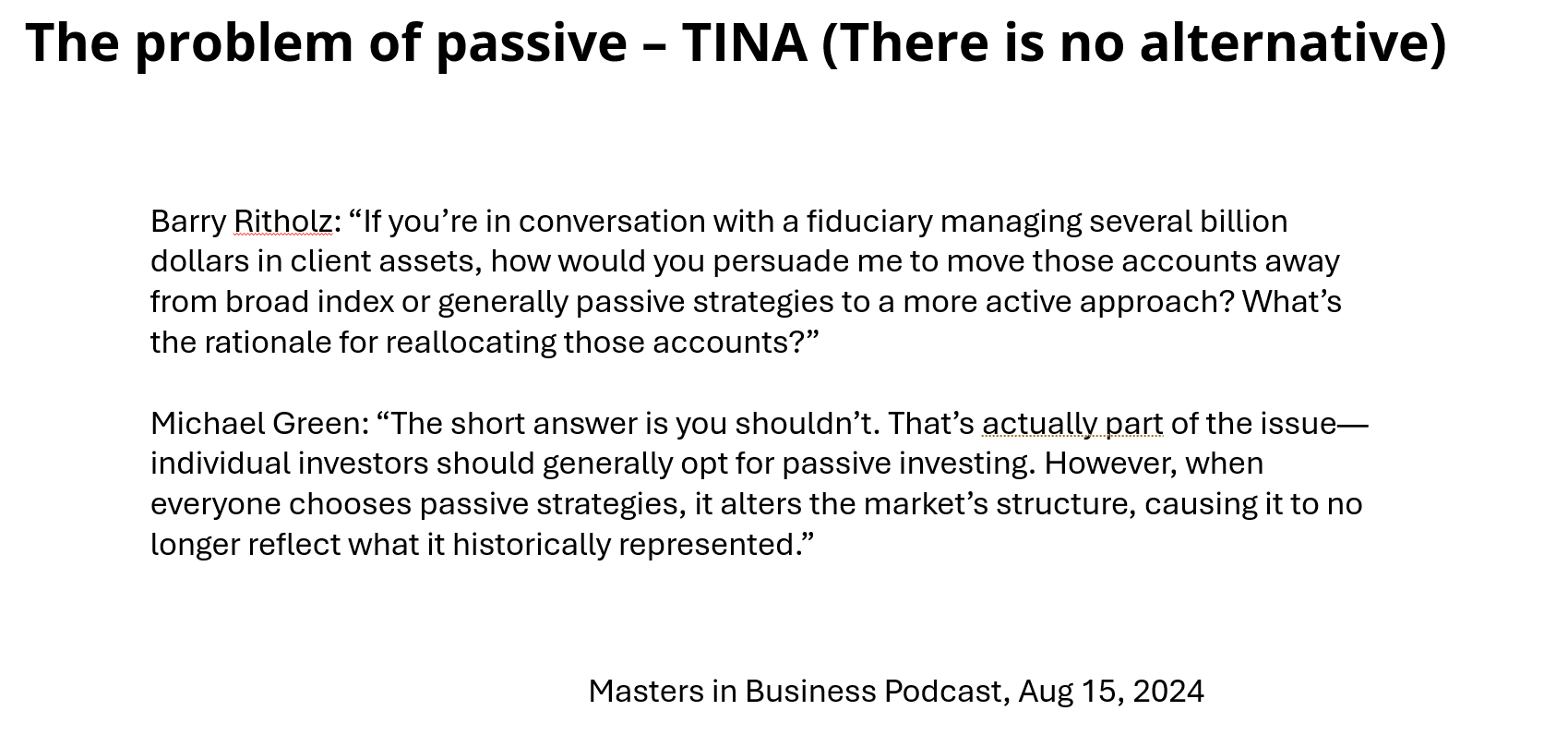
At the same time, I warned policymakers that the aggregate consequences of everyone making that individually rational decision could be dangerous.
Those statements are not in tension. They are both true.
Passive investing is individually rational while creating an aggregate externality no individual household has an incentive to internalize. The solution cannot be to lecture households into accepting higher fees or worse diversification for the good of market structure.
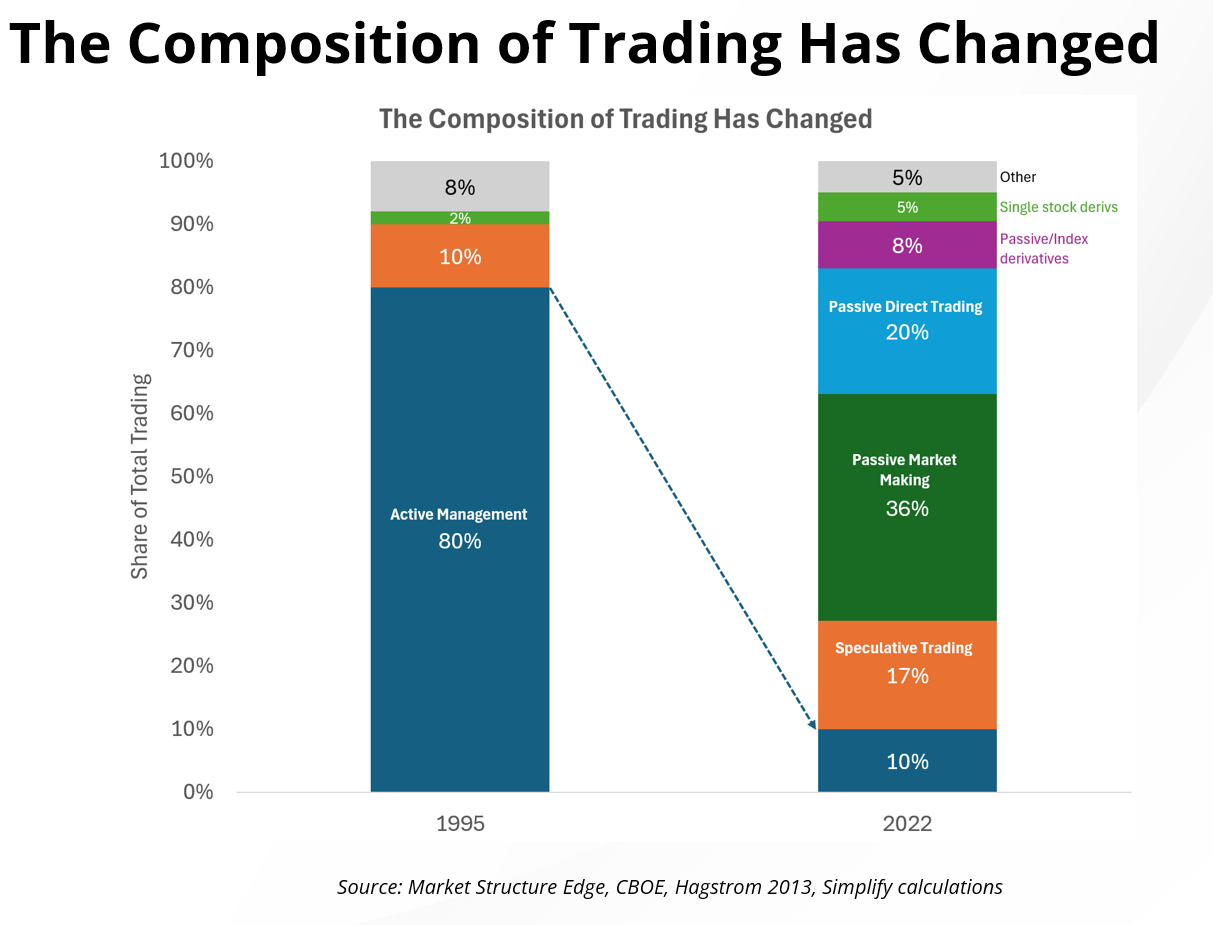
The solution has to make price discovery economically rewarding again.
I’ve concluded that the answer is not to fight passive.
You don’t beat an index fund by yelling at it.
You build for the market the index fund created.
You measure the flows, not at the fund level – at the individual security level. You understand what the adoption of benchmarks requires -- you respect the tracking-error constraints under which real allocators operate. And you spend risk where increasingly mechanical markets create identifiable opportunities.
Investment Judo
Do not fight the weight of passive capital. Measure the force, redirect the portfolio around it, and preserve the client’s mandate. The objective is not maximum active share. It is maximum useful edge per unit of governance-approved tracking error.
Not anti-passive.
Passive-aware.
A category of investing that does not yet exist.
An Admission
For nearly a decade, I gave this research away.
I published it, presented it, argued it on every podcast and stage that would have me, and walked it into the Federal Reserve and the BIS — all under a quiet assumption I never examined: I didn’t know how to translate the success of the Volmageddon trades into an alternative, so I hoped that someone with more influence than me would act on it.
A regulator would adjust the rules. An index provider would change the methodology. A hundred billion-dollar incumbent would build the product and lead the charge. Anyone but me.
No one did.
I should have known better, because I’ve said the operative principle out loud for years: the beauty of capitalism is that you don’t have to find the solution — you just have to pay the person who does.
I had found something real, and I was waiting for someone else to do the hard work. If I’m honest, I was scarred by my experience launching a hedge fund – an event I have freely labeled an unmitigated disaster for me personally. But capitalism does not care about my personal scars, nor does capitalism compensate the person who is right. It compensates the person who converts being right into a structure someone can buy.
The first trade was the research. The second trade, which it took me nearly ten years to understand, is the firm.
The Abandoned Core
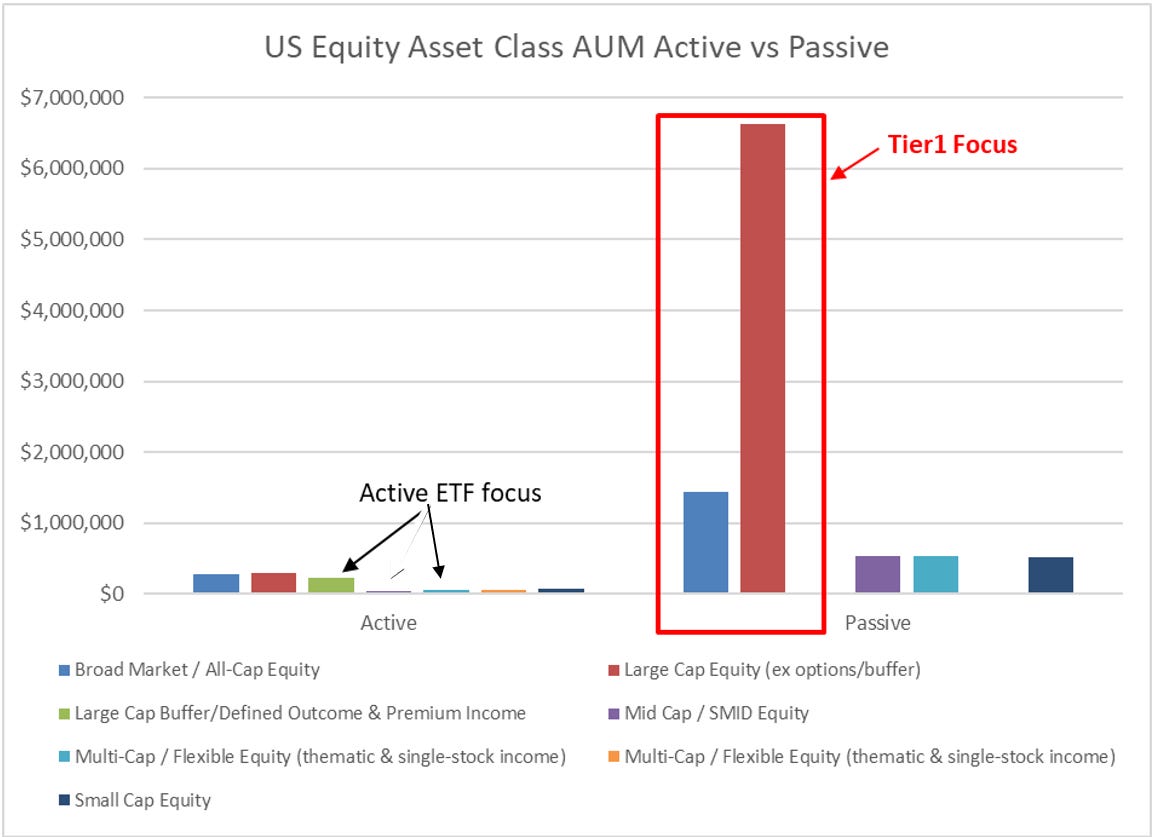
One of the strangest facts in modern asset management: the industry has largely surrendered the biggest and most important asset pool in the world — core U.S. large-cap equity — without much of a fight. Active management didn’t simply lose the core. It retreated from it.
The verdict arrived empirically. Year after year, scorecard after scorecard, most active managers failed to beat the S&P 500 net of fees. Charles Ellis told them as early as 1975 that they were playing a loser’s game. Decades of data appeared to agree.
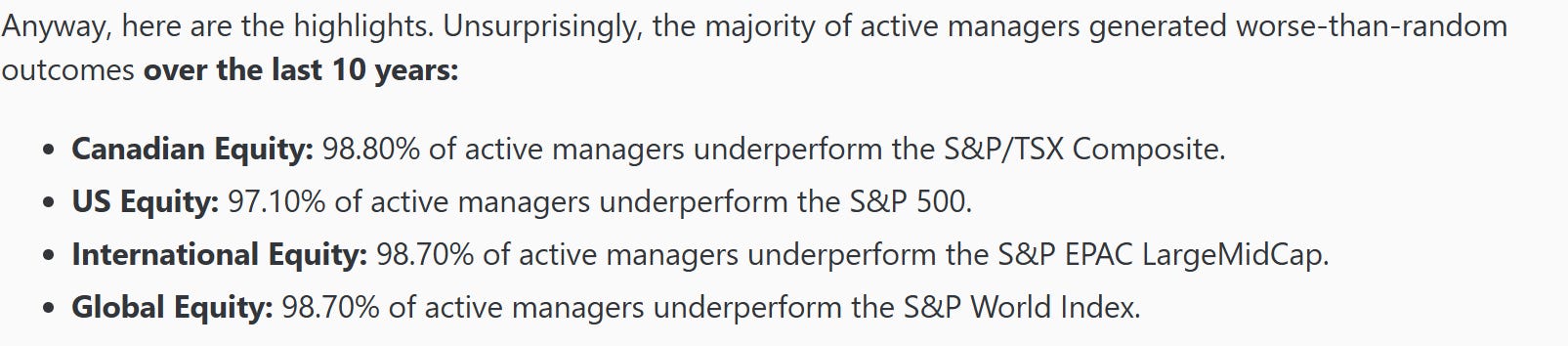
Active managers fought for a while. But they lacked the tools and insights to understand why they were losing, and so they accepted explanations that flattered the market rather than describing it. Blessed be the market.
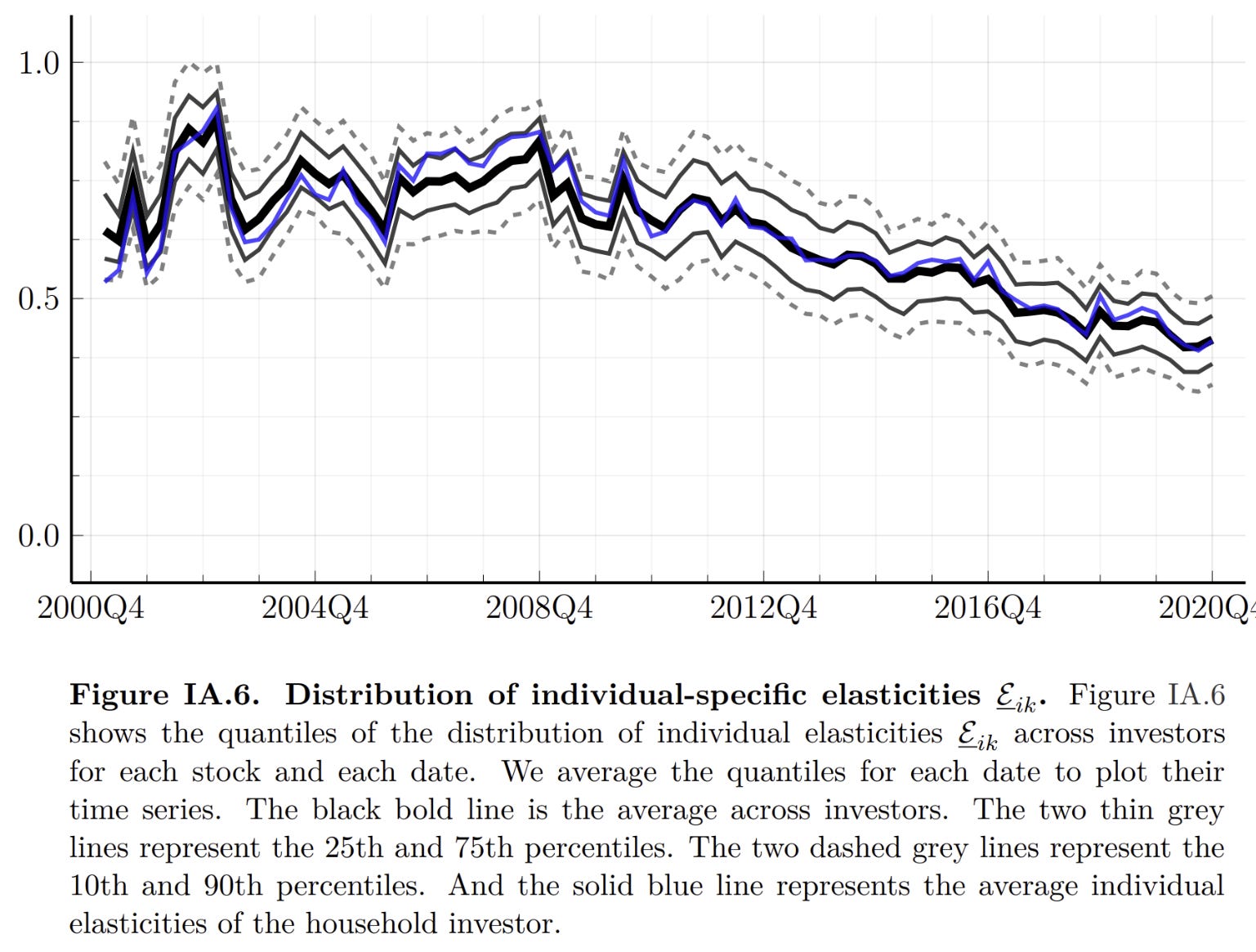
The poker analogy: the amateurs had left the table, so the remaining professionals were left feasting on each other.
The paradox of skill: talent had risen and converged, so outcomes were increasingly dominated by luck. Less noise. Fewer fools. More efficiency.
Every one of those explanations assumed the same thing: that the game was unchanged, and the players had simply gotten better. So the less arrogant admitted defeat and adopted Michael Mauboussin’s advice – “Play easy games”; or as Eric Balchunas described “a little hot sauce on an otherwise vanilla Vanguard-ian core.”
The game was not unchanged. The largest participant in the market grew to dominance and had stopped playing it. Capital flowing mechanically into capitalization-weighted vehicles presses hardest on the largest securities — precisely the securities a diversified, valuation-conscious active manager is structurally built to underweight. In that regime, the evidence suggests that benchmark-relative underperformance is not simply a verdict on skill. It is, in part, a consequence of the flows themselves, as I hypothesized a decade ago and Hannah Unterberg documented this year.
Imagine being told you are a loser, shown decades of data that seem to prove it, and offered theories that explain nothing. That is what a hopeless era looks like from the inside.
The retreat was understandable. The failure to fight back is not.
Faced with the fee compression of the index complex, managers moved toward the satellites: alternatives, privates, thematic products, niche factors, concentrated portfolios — anywhere the benchmark’s shadow was weaker and the fee pool remained defensible even if the investment case was dubious at best.
What makes this especially strange is that our industry has a proud history of converting academic findings into institutions. Dimensional Fund Advisors was founded in 1981 around the practical application of financial economics; it went nowhere for a decade. After Fama and French’s early-1990s work formalized size and value as systematic dimensions of expected returns, Dimensional rapidly incorporated that research into investable value strategies and grew into a powerhouse, at one point commanding nearly 0.5% market share, roughly $1.5T in today’s market cap terms.
Rob Arnott’s work on fundamental indexation in 2005 became RAFI and a global licensing franchise that peaked at $480B in licensed AUM despite fighting a relentless anti-value tide. In June 2026, TMX announced an agreement to acquire RAFI Indices for $490 million despite a nearly 50% decline in AUM over the last decade. The goal of most firm launches today is to build to sell, not to build a longstanding partnership with clients.
Prior academic research became products. The products became firms.
The passive-impact literature has produced something very different.
Over the past decade, a large and rapidly expanding body of work has examined the effects of passive ownership and mechanical flows on prices, liquidity, information production, volatility, elasticity, index membership, and market clearing. Hundreds of academic papers document a clear impact on market behavior. Not one firm was built to incorporate these insights.
Why?
This was not another premium that could be packaged harmlessly alongside the benchmark. The finding was that the benchmark itself — and the enormous pools of mechanical capital attached to it — had become part of the mechanism producing the opportunity. And the institutions with the greatest scale to commercialize that insight were often the institutions with the greatest economic interest in leaving the benchmark unquestioned. Acknowledge the opportunity and the regulatory favoritism is at risk.
In other words, a new entrant was required.
What Tier1 Alpha Does
The closest analog for our approach is index arbitrage — more precisely, the strategies that anticipate index additions, deletions, rebalances, float changes, and the large mechanical trades surrounding them. Strategies formalized in Lasse Pedersen’s “Sharpening the Arithmetic” became some of the largest hedge fund strategies – the profitable core around which the most successful multi-strat hedge funds are now built.
Their logic is straightforward. If you can probabilistically determine what a sufficiently large pool of capital will be required to buy or sell, you possess economically valuable information before that transaction occurs. Everyone knows the index fund must trade on rebalance. The opportunity lies in estimating what it must trade, in what direction, how much, when, and against how much available liquidity.
Our research applies the same logic to a different timescale.
An index fund does not become mechanical only on rebalance day.
Every trading day, money enters and leaves passive vehicles. Payroll contributions arrive. Retirement allocations are made. Target-date funds rebalance. Investors add cash and redeem it. And index funds must trade to accommodate these flows.
Each individual flow looks small beside an index addition or deletion. Collectively, they are not small. They are persistent, increasingly large, and substantially governed by rules rather than judgment.
Traditional index arbitrage studies the large, episodic mechanical flow and places large, leveraged bets on the outcome. We seek to measure the smaller, continuous mechanical flow (we can incorporate episodic events too, but they are not the core insight), and the frequency of the flow means we do not need leverage.
The core question is simpler:
What is the most powerful voting bloc in the market required to buy or sell?
That is the Keynesian beauty contest under modern market structure.
Keynes described a market in which success did not come from choosing the contestant you personally thought most beautiful. It came from anticipating the contestant everyone else would choose. Passive investing changes the contest: A huge portion of the electorate has published its voting rules in advance.
The passive investor does not ask which company is beautiful. Given a flow of cash and a set of index weights, the mandate substantially determines the ballot.
Our job is to understand how those flows from thousands of ETFs affect thousands of individual stocks. And that has a second-order consequence that I believe is even more important than the first: the strongest effects of passive investing are not merely that passive investors stop doing fundamental analysis. They change what becomes rational for active investors to analyze. If the largest marginal buyer or seller becomes increasingly predictable, the remaining discretionary investor has a new choice. They can estimate the fundamental value of the security and wait for price to converge toward it. Or they can estimate what the largest mechanical voting bloc is about to do.
If the second activity pays better than the first, active capital should adapt. In ordinary arbitrage, the arbitrageur usually trades against the distortion and helps eliminate it. In a market increasingly driven by predictable mechanical flows, the rational arbitrageur may choose to trade with the distortion:
Passive buys because it must. Active investors learn to anticipate the purchase and buy first.
Passive sells because it must. Active investors learn to anticipate the sale and sell first.
The attempt to arbitrage the flow can amplify the flow. Tier1 Alpha Asset Management converts that research program into investable portfolios.
Our flagship implementation holds essentially the same securities as the leading U.S. large-cap benchmark, then tilts modestly and systematically toward the securities where our measurement suggests passive demand is strongest relative to available liquidity and away from — or underweights — those where the opposite is true. No intentional sector or style bets. A quantitative overweight to what matters in today’s markets.
Traditional index arbitrage predicts the consequences of a change in the index portfolio. We seek to predict the consequences of money moving into a fund that must convert that cash into a position without a change in the index.
The constraint everybody knows and nobody says out loud
Knowing what you want to own is not enough. You have to build something investors are actually able to own. For benchmarked core equity, tracking error is scarce currency.
Institutional portfolios operate under explicit active-risk budgets. A strategy can have attractive expected returns and still be unusable if it consumes too much of that budget or behaves too differently from the benchmark it is meant to replace.
That constraint helps explain why active managers retreated toward the satellites. The strategies easiest to differentiate commercially were often the strategies hardest to put in the core.
Tier1 starts with the opposite constraint.
We ask how much deviation from the benchmark an allocator can actually tolerate, then try to spend that deviation where the information has the greatest expected value.
Low tracking error is not a consolation prize.
Properly used, it is a superpower.
A strategy that preserves the benchmark’s basic risk profile while spending a limited active-risk budget intelligently can sit at the center of a portfolio rather than at its edge. It can potentially fit into platforms and model portfolios that exclude high-deviation products. It can serve as a direct benchmark replacement rather than another satellite position. And its benchmark-like chassis can support derivative overlays, defined-outcome structures, and income strategies built on top of it using the most liquid derivatives markets.
Core implementations allocators can actually use, and dynamic strategies for the moments when market structure turns hostile. ETFs for RIAs and retail; SMAs and hedge funds for institutions. All built on the same underlying research.
More detail will come as products launch and regulatory processes complete. With active registrations underway, compliance means I cannot share more at this time.
The team is a familiar one. Tier1 Alpha Research, built alongside Simplify to fund my work on market structure, forms the core. Craig Peterson, whose systematic-flow and volatility research many of you already know from Tier1 Alpha’s research arm, leads research. David Pegler leads distribution. A team that has worked together, argued together, and published together for years. In addition, we are working with friends in the white label ETF world to quickly operationalize at institutional scale; a temporary concession that reflects the extraordinary regulatory burdens that have made founding institutional-quality firms ever more challenging. New hires are signing on, and strategic partnerships are underway.
Why Now?
I have made this bet before.
In late 2020, the Securities and Exchange Commission adopted Rule 18f-4, creating a modern framework for mutual funds and ETFs that use derivatives. The rule did not invent derivatives or the strategies built with them. It changed which strategies could be delivered efficiently through an ETF.
I joined Simplify in 2021 because I understood what that change made possible. Techniques that had largely been confined to hedge funds and institutional accounts could now be packaged in a transparent, tax-efficient vehicle available to ordinary investors. Simplify was designed around that opening. That change helped power the firm’s growth.
The opportunity in front of Tier1 is similar, but much larger.
The Department of Labor’s 2024 Retirement Security Rule sought to expand the circumstances under which retirement investment advice would create fiduciary status. It did not prohibit higher-fee products or require the selection of the cheapest fund. But it increased the potential burden associated with recommending anything that cost more than the lowest-priced alternative.
The rule was stayed before taking effect and ultimately vacated in March 2026, restoring the five-part test that had governed fiduciary status since 1975.
That did not eliminate fiduciary responsibility. Advisors and plan fiduciaries must still conduct meaningful due diligence, compare reasonable alternatives, monitor their selections, and act in the client’s interest. A manager cannot justify a higher fee by pointing to a clever story or a favorable backtest.
But the change restores a question that the regulatory and litigation environment was in danger of answering automatically:
What if the higher-fee product is better?
Not more marketable. Not more exciting. Better.
What if additional basis points pay for research that identifies a persistent market distortion? What if the strategy remains liquid, diversified, and close enough to the benchmark to serve as the center of a portfolio? What if the manager can explain the mechanism, disclose the risks, provide evidence, and permit the allocator to evaluate whether the additional fee was earned?
A fiduciary should be allowed to ask those questions. More importantly, a fiduciary should be allowed to answer them affirmatively.
The rule never prohibited higher-fee products, and it never took effect. But its direction of travel strengthened an already powerful presumption: when two products occupy the same portfolio box, the cheaper one is easier to defend. The vacatur did not make Tier1 legal. It restored enough regulatory clarity for advisors and retirement allocators to evaluate whether a modestly higher fee pays for meaningful research rather than treating the fee difference itself as the answer.
That clarity matters because Tier1 is being built for the center of the portfolio, where the burden of defending any deviation from the cheapest benchmark is highest.
The parallel with 2021 is direct. Rule 18f-4 expanded the set of strategies that could be placed inside an ETF; I joined a firm built to pursue that opening. The fiduciary-rule vacatur expands the set of judgments that advisors and allocators can reasonably defend.
Why tell everyone?
If this works, why am I explaining it? Because the theory is not the measurement.
Index arbitrage provides the precedent again.
The fact that an S&P 500 index fund will have to buy an addition is not secret. Everyone can know the rule. That does not mean everyone knows the eventual flow, the positioning already in the market, the liquidity available to absorb it, or the resulting security-level price impact with equal precision.
The valuable information lies in the implementation. The same distinction governs Tier1.
We publish the theory and license the architecture for the index, but we protect the daily, security-level measurement that sits behind it.
Competition can reduce any investment edge. But the flow we measure does not exist because investors discovered a profitable trade. It originates outside the trade — payroll contributions, benchmark mandates, statutory structures — from capital whose rules do not change merely because someone learns to anticipate them. And an investor who does anticipate them initially trades in the same direction as the flow, reinforcing the mechanism before passive funds arrive to deliver its expected return. The index membership effect monetized.
Front-running rules prohibit the misuse of material, non-public information about imminent customer orders. Tier1 possesses no such information. We observe public index methodologies, public mandates, and measurable market flows, and estimate the transactions those rules are likely to require. Anticipating the consequences of public rules is analysis; I have no doubts that we will see competitors if our products succeed. That is good.
Our intended footprint remains small relative to the flows we measure at almost unfathomable scale. The flows are astronomical relative to our footprint. Wider adoption does not create the underlying compulsory demand or supply. It creates additional capital responding to it. And unlike the hot sauce and levered funds, the mismatch is huge.
The Covenant
But I did not leave Simplify just to launch more ETFs. If Tier1 were only a product company, it wouldn’t be worth the disruption. A healthy market needs both inexpensive beta and well-paid dissent — cheap index exposure for investors who want it, and genuinely active managers compensated well enough to fund research, take risk, disagree with the market, and keep prices informative. And our work suggests the insights generated by our proprietary analysis — the isolation of the “passive factor” — extends into a hybrid form of active management. Not for our initial products, but for collaborative projects with select active managers; the proverbial “players to be named later” in both style and multi-strat form.
The race to zero fees produced enormous benefits. It also confused cost with value. Markets cannot indefinitely free-ride on information nobody is being paid to produce.
So Tier1 is being built around a set of commitments, and the first among them is this:
We oppose rents, not fees.
Legitimate fees compensate research, judgment, risk-bearing, implementation, and scarce capacity. Illegitimate rents monetize captivity. And the rent is too damn high today.
Tier1 will not pay asset-based shelf fees, placement fees, or platform-access tolls merely to buy distribution — and we will not operate that tollbooth ourselves through stacked or concealed fees.
In 1977, Vanguard converted to no-load distribution, eliminating an initial sales charge that could reach 8.5 percent. Vanguard itself later described the change as becoming a “no-load company.” The decisive early advantage was not a basis-point war over management fees. It was bypassing the broker network and putting every dollar of the investor’s capital to work.
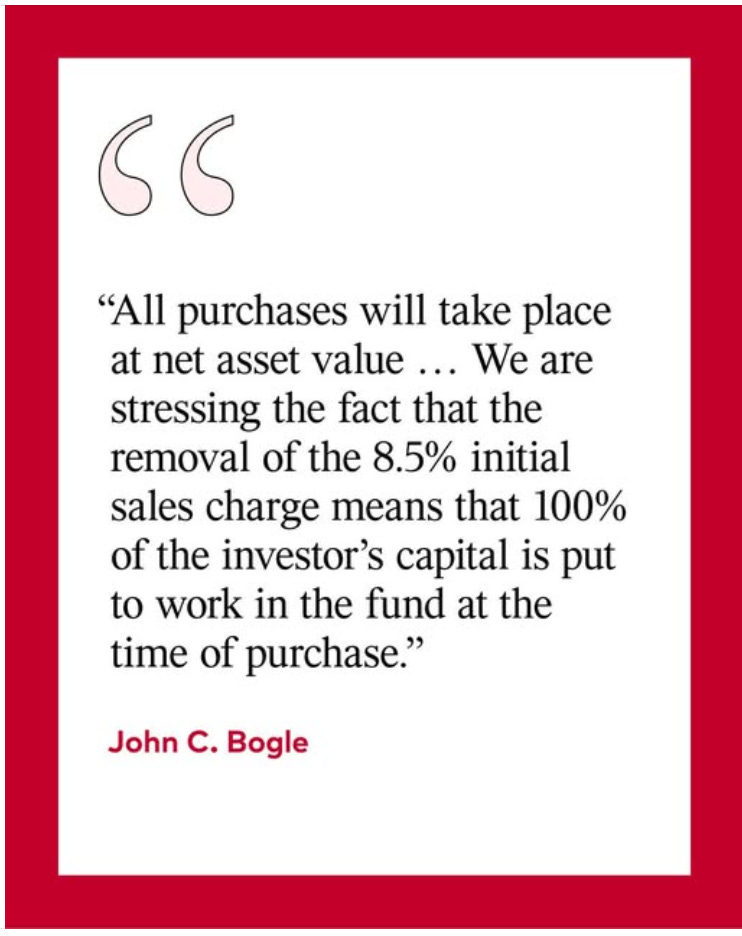
Jack Bogle refused to sell load funds because his direct access to investors gave him the ability to refuse. Today, the industry celebrates cutting three basis points to two—a trivial difference in most investors’ realized returns, but a potentially meaningful legal and distribution advantage over a researched product charging more. The investor benefit has become a competitive moat.
The precedent cuts both ways
I have to be careful with the Vanguard story, because the institution that taught the lesson stopped following it.
Bogle never patented the index fund. The First Index Investment Trust was copied freely, and Bogle treated the copying as vindication of his vision. In 2003, Vanguard patented something else: the structure that allows an ETF to operate as a share class of an existing mutual fund. The structure is enormously valuable to investors — by one published account, funds using it booked roughly $191 billion in gains through 2019 while distributing essentially no taxable capital gains. For twenty years, investors in competing mutual funds were denied access to a structure that could have reduced their capital-gains distributions. The benefit was withheld not by regulation or by physics, but by a government-granted exclusivity held by the one firm founded on the principle that fund economics belong to fund investors.
The exclusivity was entirely legal. Rents usually are. When the patent expired in May 2023, more than a dozen managers — Fidelity, Schwab, Morgan Stanley, Dimensional, PIMCO among them — filed within months for the relief Vanguard alone had enjoyed for twenty years.
Nor was the patent an isolated example. In late 2020, Vanguard opened its lower-cost institutional target-date funds to smaller retirement plans. A migration out of its retail target-date funds followed, and the selling required to meet those redemptions produced historically large capital-gains distributions — a tax bill borne by the taxable retail investors who stayed. The smallest clients. The ones the firm was founded to serve. In January 2025, Vanguard agreed to pay $106 million to settle SEC charges that it had made misleading statements about those distributions.
Bogle built the firm on a single sentence: the fund investor comes first. The modern institution patented a tax benefit away from every other firm’s investors for two decades, handed its own retail investors the tax consequences of courting institutional scale, and settled with its regulator over how it described the damage.
Oh, and check out the fees on Vanguard’s most recent foray into private assets. Coming soon to a 401K near ewe.
“In terms of the company, they're going into a lot of different areas that the Bogleheads aren't thrilled with or think that are un-Bogle-ian. And I'm torn. I think on one hand they're not--Bogle was more pure, I think, than the company-- is going. On the flip side. You could argue that maybe wealth management needs a little more disruption, maybe private equity needs some disruption. ETFs certainly were a place he didn't want them to go, but I think most people are happy they did.” — Eric Balchunas
That is what abandonment looks like. Not a betrayal announced in a press release — a sequence of individually defensible decisions, each choosing the institution over the investor, made by a firm grown too dominant for any single client to punish. No villain is required. Scale creates the temptation, and incentives do the rest.
And if Tier1’s own scale someday (hopefully) creates the same temptation, the test we ask you to apply to everyone else will apply to us: show where the cash flow changes. The full investment case — including the evidence that would prove us wrong — is outlined in our research agenda to continue to challenge our theories on passive impact. We always assume we’re wrong. The scientific method demands falsifiability, not belief.
I’ve spent ten years telling you what I think is wrong with market structure. My readers have generally grown to trust me for speaking truth to power; now let’s wield it.
You want change? Ask for it.
The audience is part of this wager. Vanguard became a fund investors asked for rather than one brokers were paid to sell. Admittedly, Bogle’s access to Wellington Management’s client list allowed them to know the potential client base in a way unavailable to most startups. Largely by luck, we have some of the same capability; but Tier1 can refuse the tolls only if demand reaches the platform another way.
If you want access to Tier1 when our strategies become available, tell your financial advisor:
“I want to know when Tier1 Alpha strategies become available. Please request access through my platform—whether through a fund, an SMA, or a licensed implementation—and let me know what stands in the way.”
A platform can ignore a new asset manager. It is harder to ignore its own clients. Every request makes the demand visible and helps us determine which platforms, products, and licensing channels to build first.
We cannot refuse to pay for access and then wait quietly for access to appear. If you want an industry that rewards research rather than tollbooths, let your advisor or investment committee know about Tier1. They may give a fig as well.
What changes for you, and what doesn’t
This Substack continues, largely because of my readers’ poor behavior in sticking around for subpar insights. It’s not going anywhere any time soon. Some of my writings may shift from markets to firm updates; I promise you, these will be written poorly and delivered with the grace of nails on a chalkboard. But if compliance will LET me write it unfiltered, it will be delivered as unfiltered as possible.
The research continues, and it deepens, because for the first time the research program and the firm are the same thing. Our research agenda is almost entirely focused on (1) “How can we be wrong?” and (2) “How can we capitalize on our insights more effectively?” These insights will form the core of the firm’s website, www.tier1acapital.com, which we hope to turn into the clearinghouse for all things passive. Might even throw a few recipes up there. BlackRock BBQ, State Street Soufflés, Vanguard Venison (unlikely, not a big game guy and no one wants Lyme disease by proxy).
The book is coming. A bit later (the nine-year anniversary of Volmageddon on Feb 5, 2027 is our new target date), but it’s coming with a new chapter.
My obligations will require more disclaimers and occasionally more silence than you’re used to from me, and I ask your patience with both. The early institutional response to our strategy has been astonishing; I described it this past week as if I’d opened a door and a vacuum began pulling me forward. And I am glad I am able to share this adventure with you. My children are now all grown; I needed a new baby.
Nearly five decades ago, early in his career, Bill Gross pitched the business of active management over dinner in two words: we sell hope.
He was right.
Hope deserves a price. And when the economics are honest and the claim can be measured, the clients will follow. Or so I’m betting with the rest of my career.
The market changed. The industry changed too — for the worse. Incentives matter. Let’s make it better.
It’s time to complicate.
— Michael W. Green
