A couple of housekeeping thoughts on recent posts from the “intelligentsia.” Matt Yglesias, who has been a fixture of the “left” media since 2002, has recently come under fire from the left for his defense of the status quo, suggesting a return to Obama-style neoliberalism, unfettered free trade, and business-friendly policies. I offer conditional condolences and partial agreement, even as I encourage readers to consider that our current system is extractive and poorly suited to “the pursuit of happiness” for the majority of Americans.
But Matt hits on an important theme in this post, defending billionaires, even as he betrays his alignment with them (one does not simply “think” about billionaire positivity while on vacation in Maine). It’s possible to reform the system without targeting the individuals. In fact, as I’ve noted in many responses to comments, as “good” as retribution may feel temporarily, it’s a societal trap:
I know many billionaires and would echo many of Matt’s sentiments about them as people. It’s key to remember that:
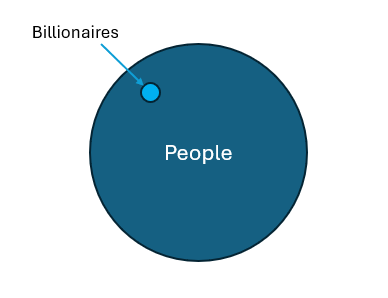
A sizeable fraction of the US Constitution is built around prohibitions on legislation targeting an individual or group, on ex post facto laws, etc. Billionaires are people — often remarkably hard-working, innovative people; sometimes people who have colored (and continue to color) outside the lines. As a nation, we should encourage the former and discourage the ACTIONS of the latter. Laws are prohibitions against acts; they should never be targeted at PEOPLE.
We need to tone down the rhetoric against people and focus our rhetoric on reforming the system. If Jews, or Muslims, or LGBTQRSTUVWXY, or billionaires are targeted, they will understandably resist. And targeted billionaires are dangerous. Noah Smith, whom I don’t always agree with (unsurprisingly), but always appreciate, has by far the best rationale for billionaires:
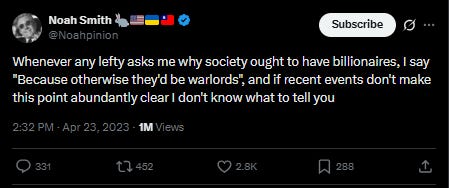
Revolutions are not led by peasants. Revolutions are led by dissatisfied elites. The peasants are cannon fodder. Something to think about as the cries to “burn it all down” grow louder.

In the same vein, I’m reading more and more about “kids these days.” The literature shelf on this subject is long and tired:
"The children now love luxury; they have bad manners, contempt for authority; they show disrespect for elders and love chatter in place of exercise. Children are now tyrants, not the servants of their households. They no longer rise when elders enter the room. They contradict their parents, chatter before company, gobble up dainties at the table, cross their legs, and tyrannize their teachers." — Socrates ~450BC
But I was struck that Suzy Welch, a noted fan of geriatric billionaires (the second wife of 24-year-senior Jack Welch), has found rebirth advising companies on how to weed out troublesome youngsters. A September 24th, 2025 WSJ editorial asked the question:

And concluded that with Suzy’s help, companies, “if armed with data, could become more targeted in hiring efforts, racing to find the 2% before competitors do.”
Jack Welch was notorious (and lauded) for ruthlessly firing the bottom 10% of employees. With Suzy’s help, companies can exclude 98% of Gen Zers. You should read the article if you have access. But one passage struck me, given my recent focus on “happiness.”
Our first step was to analyze Generation Z’s values in order. In first place is eudemonia, a Greek term my inventory uses to encompass the desire for self-care and personal pleasure. Next comes voice, the value that reflects the priority a person places on expressing authentic individuality. Third, non sibi, the Latin term meaning “not for oneself,” the desire to help people. Fourth is affluence, exactly as it sounds, and fifth, “beholderism,” a desire for things—including yourself—to be beautiful. — Suzy Welch, WSJ 9/25/2025
“Hey Gemini, is ‘eudemonia’ a Greek term that ‘encompasses the desire for self-care and personal pleasure’?” — “No, that’s hedonia, the root of hedonism.”
In my opinion, this misunderstanding sits at the heart of nearly all “kids these days” complaints. Growing up is all about the transition from hedonism to eudaimonia. It’s a transition that, for me, arrived nearly instantly with the birth of my first child at 29. A preview was on New Year’s Eve 1999, when the highlight was the first feel of a baby’s kick (he was massively hopped up on sugar from the three desserts my very pregnant wife had inhaled). Suddenly, joy was no longer derived from river-rafting trips around the globe (6 of 7 continents in my 20s), but from the experiences of parenting and partnership — and the freedom that a little bit of success gave me to explore financial markets. My hunch is that Gen Z will undergo a similar transition; I’ve certainly seen it begin in my children:
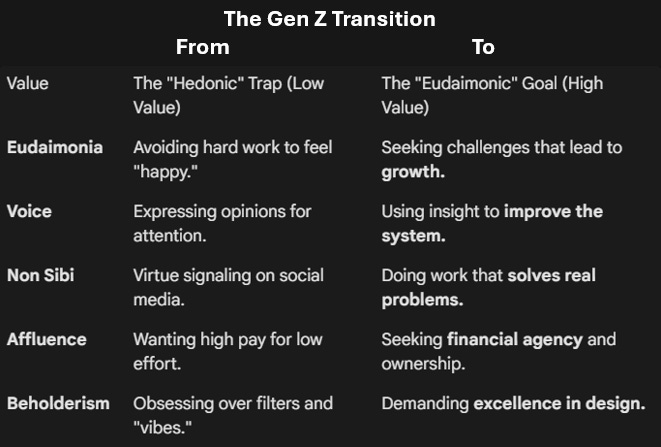
Just like Baby Boomers (hippies), Gen X (slackers), Millennials (whiners), and 5th-century BCE youth in Athens, Gen Z (hedonists) will transition to adulthood. And the transition will bring changes for ALL of us. The transition did not go well for Socrates, and my hunch is this will not go well for the Boomers (or Gen X, for that matter).

But before that transition is complete, the proverbial “Fourth Turning”/”End Times” is well underway. Last week, I explored this transition in the context of emergent scarcity, particularly for electricity. This week, I’d like to consider the implications for the most obvious “commodity” dependent on cheap electricity — Bitcoin. (BOO! HISS! SALTY HATER!!!)
The Great Re-Pricing: When the “Digital Gold” Bill Came Due
In April 2025, I asked a simple question in my note, “What is Gold?”:
“If the $1.7 trillion now sitting in bitcoin had flowed into bullion instead, what would the yellow metal trade at?”
My models suggested that bitcoin acted as a “shadow discount” on Gold, depressing its price by 30–50% by diverting monetary flows into a faster, digital horse. I argued that if those flows ever reversed—if the “Passive Bid” for bitcoin evaporated—Gold would violently re-rate to where it belonged.
Eight months later, we have our answer. In 2025, bitcoin and Gold flows became negatively correlated: