
Disclosure: Earlier this year I sent Treasury Secretary Scott Bessent a proposal called the Sovereign Debt Optimization Facility: a voluntary tender exchange of deep-discount vintage long bonds for current-coupon par bonds. Treasury did not announce that proposal last week. It announced a cash buyback program, materially different in both mechanics and optics.
I have had no communication with the Secretary since sending the proposal, received no nonpublic information about the decision, and learned of the announcement when everyone else did. Everything here comes from public prices, public announcements, and public data. If I infer an intention to Treasury, I am reading the tape, not a text thread.
Bottom Line
The long-end selloff is a real-rate and term-premium event, and the buyer base changed underneath it. Three facts frame the argument:
• Forward inflation barely moved in the latest leg. The 5-year, 5-year forward inflation rate stayed inside roughly a 20-basis-point range this year while the Kim-Wright 10-year term premium rose about 32 basis points from mid-February through mid-August.¹⁷ That 32-basis-point move is not the beginning of the repricing; it is simply the cleanest recent window in which the inflation leg stayed quiet while the term-premium leg moved.
• The old structural buyers have been stepping back for years, not since February. QE stopped adding duration, higher U.S. rates broke the economics of the Japanese hedged bid in 2022, the Russians and Chinese ceased buying in summer 2022, corporate pensions largely finished their great defeasance wave in 2023, and the Fed spent the following years running down its portfolio before reopening the warehouse mainly in bills.²¹
February 2026 matters for a narrower reason:
Treasury’s TIC data gives us a particularly clean new footprint, with foreign official holdings down $233 billion from the February peak, Japan down $123 billion from an all-time high, and foreign private holdings rising over the same period.¹⁶
The market still clears. The August 30-year auction drew $66 billion of bids for $25 billion of bonds. It cleared at a 2001-high yield, but it cleared.¹⁸
That combination matters. The debasement story requires the long inflation forward to move; it largely did not. The buyers’-strike story requires auctions to fail; they did not. What changed was the price investors demand to warehouse duration. The question is, “Why?”
Three readings fit the history.
The term premium may simply be normalizing after a decade of official suppression.
It may be pricing the unsustainable fiscal path.
It may be the scarcity price created when captive buyers disappear faster than discretionary balance sheets can replace them.
I think the third explanation is badly underappreciated, but history alone cannot allocate the latest 32-basis-point leg among the three, much less pretend the longer repricing began in February. Fortunately, the next month gives us a better test. Warsh speaks at Jackson Hole on August 28; Treasury’s expanded buybacks begin September 9. The hypotheses should respond differently, provide tests at the end of this piece that can be monitored to help us understand better.
The key idea should feel unsurprising, but carries a message of surprising importance: the reaction function of the long end may have changed because the guiding behavior of its marginal buyer changed.
The buyer who left the market was largely unlevered, liability-matching, and indifferent to most financing conditions (FX hedging was a key consideration). The buyer being asked to replace him is either:
increasingly levered, financed, and volatility-constrained.
an improperly specified purchasing model that buys bonds as if they were equities — market value weighting
As a result, models estimated across decades of the old ownership regime may therefore misprice what a change in the policy path does to the long end. That is a claim about transmission, not a petition for cuts, and certainly not an allegation of nor invitation for coordination.
The Howling
Last Wednesday, Treasury announced that it would at least double routine long-end buybacks, from the roughly $2 billion operations running since 2024 to at least $4 billion per operation beginning September 9.¹ The 10-year yield fell six basis points and the 30-year fell nine.²
The language arrived: a “heinous financial crime.”³ ⁴
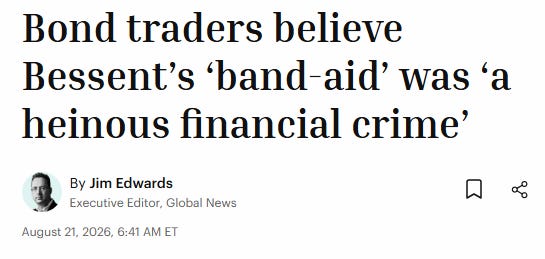
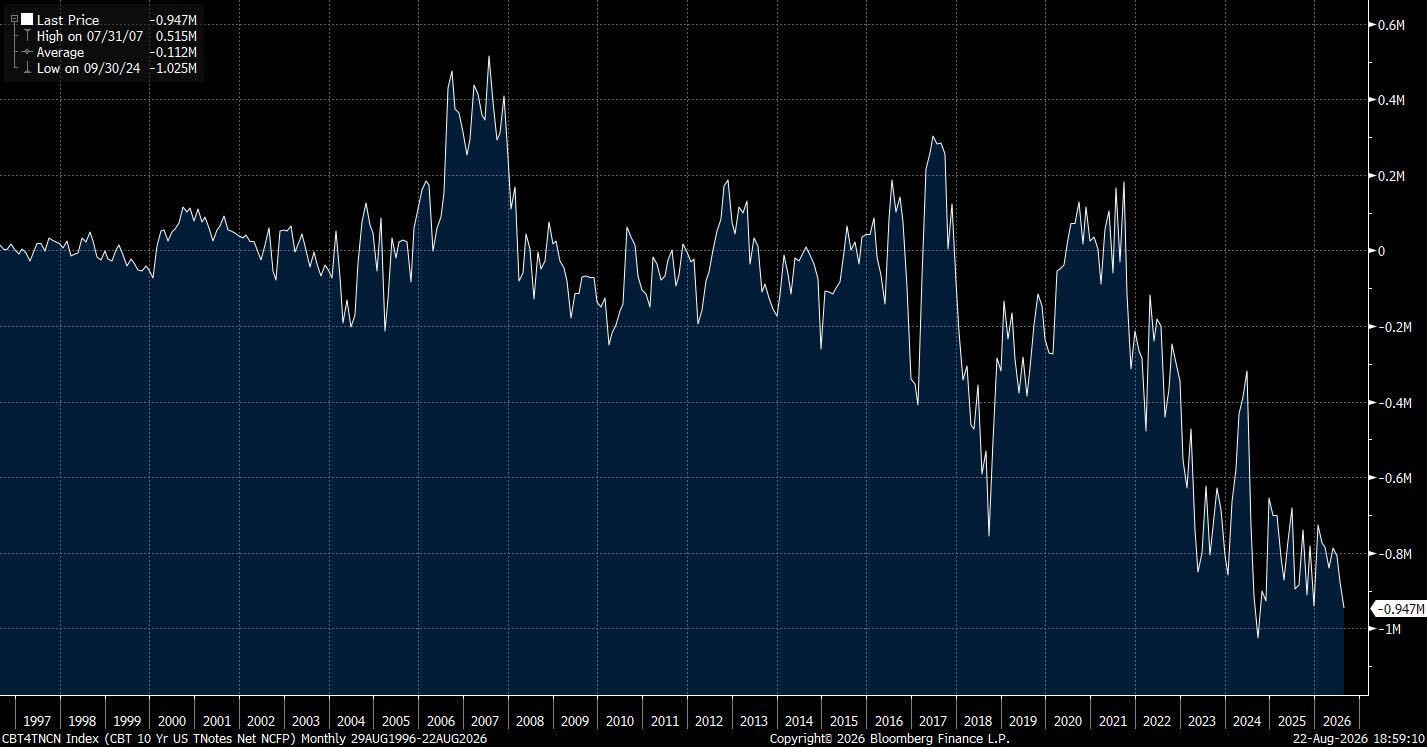
Sit with the phrase for a moment. The sole issuer of United States Treasury securities announced that it would repurchase some United States Treasury securities. No holder will be compelled to tender, no contract was altered, and the cash flows printed on every bond remain the cash flows printed the day before. Yet the “professional” reaction reached for crime. I wonder why? Oh yes, bond speculators are record short bond futures.
Markets have a funny moral vocabulary: when a price moves against a trading book, it is “near-term volatility”; when the issuer acts and the price moves against the same book, it becomes manipulation. Nobody called the 30-year’s move to a 19-year-high yield a heinous financial crime; that was “the market repricing fiscal reality,” which happened, conveniently, to be the profitable direction for everyone short duration. The US Treasury offering a proposed increase in an existing program with voluntary exchange that he believes will lower US taxpayer funding costs becomes a “heinous financial crime.” We are a weak people.
As I noted in my “unexpected” post this week, a byproduct of the announcement literally coming out live during a podcast appearance, this is the start of the aircraft carrier turn. The CFO of the United States has realized his capital stack is being mispriced to the detriment of his shareholders and has executed his first legitimate move. The buying has not yet begun, and the announced amounts are small. But I sense, with disclaimers restated from above, that this is important.
By the next day yields were climbing again, but a new language arrived: “band-aid on a bullet hole”
Treasury and bond traders are not friends engaged in a collaborative seminar on price discovery. They are counterparties. Treasury’s stated objective, in TBAC’s own formulation, is to minimize expected borrowing costs and their volatility over time while preserving the depth, liquidity, and predictability of the market. Duration investors demand compensation for taking the other side of that objective. Traders exist to facilitate transmission between the two parties by taking speculative bridge positions. When the traders book has grown in size beyond all precedent and that size is SHORT, if you are the Treasury Secretary you WANT to hear them howl. In short, I repeat the title of this piece: “Great, Scott.”
What Actually Moved
Take the closes day by day, synchronized. On announcement day the 10-year fell from 4.71% to 4.65% and the 30-year fell nine basis points.² The 10-year breakeven closed unchanged, which means the entire first-day move was real yield: roughly 2.41% to 2.35%. The next session nominals retraced four basis points while breakevens rose four, to 2.34%, the highest since early June.⁶ Real yields stayed where they had landed. Across the two-day window, nominals were down two, breakevens up four, and real yields down six. If the US Treasury wanted proof, they have to acknowledge we passed the first test.
And nothing had been purchased. The expanded operations do not begin until September 9. The repricing was anticipation: of duration withdrawal, of issuance composition, of Treasury’s revealed willingness to manage the long-end stack, and probably of some positioning adjustment against a futures market this lopsidedly short.
Zoom out and the same decomposition survives, but the chronology needs to be stated correctly. The 32-basis-point Kim-Wright term premium (an academic model described here) move from roughly 0.52% in mid-February to about 0.84% by mid-August is the latest leg of a longer post-QE repricing, not its beginning.¹⁷ The long end has been losing captive demand in stages: the Japanese hedged bid was damaged by the 2022 rate shock, Russia and China as marginal buyers by US foreign policy, corporate pension defeasance largely ran its course in 2023, and the Fed’s balance-sheet support was withdrawn for years before returning in a much shorter form.²¹ What makes the 2026 window unusually useful is not that history started there. It is that the 5-year, 5-year forward inflation rate stayed between roughly 2.13% and 2.34% while the term premium moved sharply and TIC simultaneously gave us a visible official-to-private rotation.⁷ Kim-Wright is a nominal residual, bundling duration compensation with inflation-risk premium and model error; the clean observation remains the TIPS decomposition. The broader series shows the move is real-side. The longer history tells us the buyer transition has been building for years.
When nominal yields reprice and long-run inflation compensation does not, the market is repricing the real rate. That does not defeat the serious bond-vigilante case. The vigilantes, if they are right (which I doubt), live in the real term premium and that remains elevated. The argument remains whether that real-term premium increase is fundamental or technical in nature.
I will concede the small breakeven move is not dispositive. Four basis points close-to-close, perhaps six or seven intraday, is the market’s inflation invoice for the announcement.⁶ Against six basis points of real-yield relief, it is not zero, but neither is it a regime break.
