Anchors Aweigh, My Boys
The buyer who never checks the price.

Thank you for the many kind comments on the new Tier1 Asset Management launch. I appreciate the support and will honestly say it is helping propel me through the 18-hour days I’m working.
To answer a repeated question, Tier1 plans to offer both ETFs for all and SMAs (separately managed accounts) for institutional accounts. We expect to register two ETFs in the coming weeks, at which point I’ll have to go quiet due to compliance
It's been an incredible week as we’ve started bringing on our operational team and continued improving our tech stack. To put it in perspective, when we had our first breakthroughs in September 2025, it took us roughly 45 minutes to process a single security. Craig now has that below a few seconds. This has enabled us to build a proprietary database that tracks every flow from every ETF into every stock. Our end goal is sub-0.1 second per security, which will allow us to begin tackling bonds.
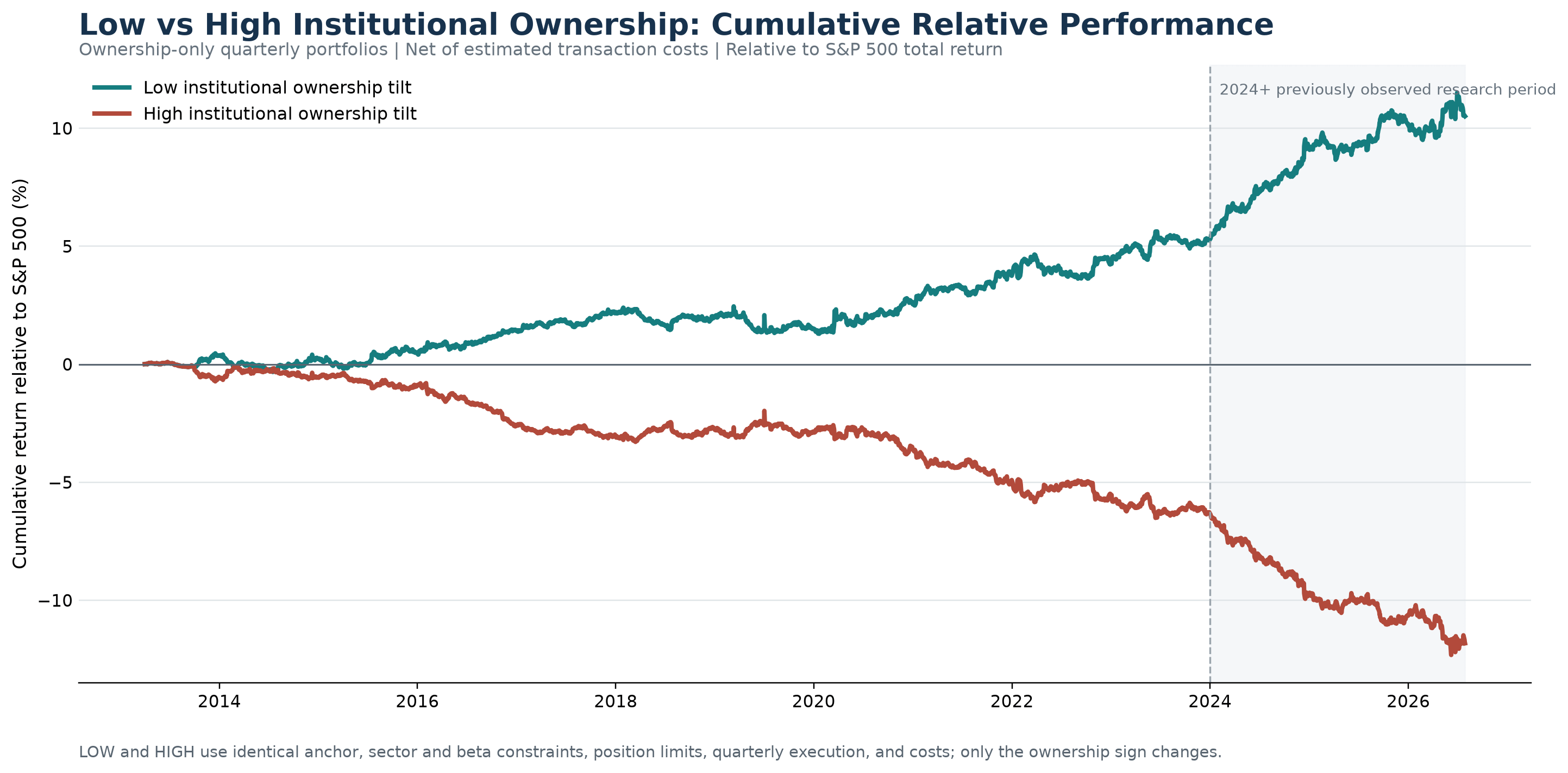
The analysis now allows us to distinguish passive flows from the remaining active flow. If you’d like to understand the challenges of active management, I ask you to ponder this chart, which separates “ex-passive” institutional ownership into high- and low-ownership cohorts. You know what’s worse than a crowded trade? A crowded trade where the crowd is leaving:
The chart looks suspiciously like this chart from my longstanding presentation on passive impact:
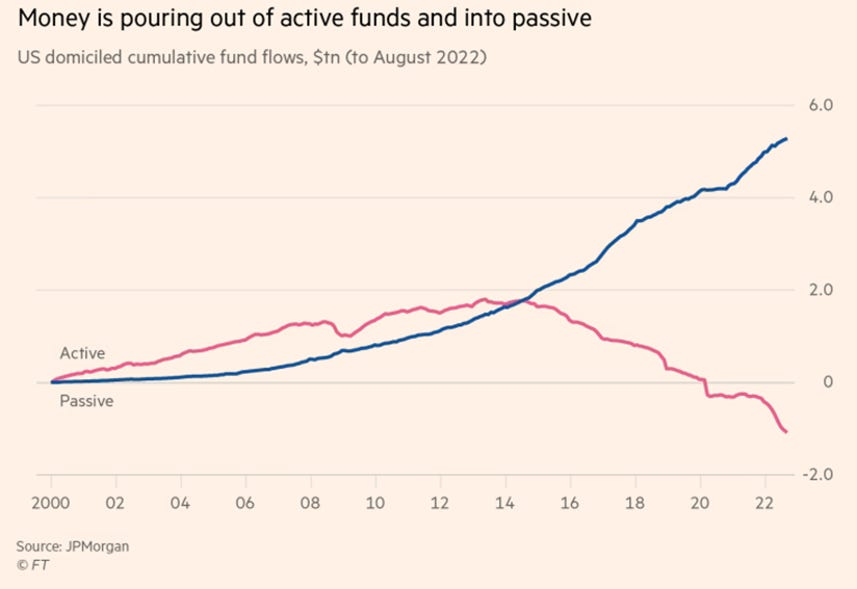
I’ve said it for a decade: “We have built the active manager killing machine.” Flows matter. Tier1 is building products that are flow aware. If you’re an institutional allocator, feel free to reach out to Tier1 to learn more.
This will be my last market-oriented post for the next five weeks. Since I’m not actively running a portfolio, I'll spend less time on markets and more time on an outlook for society. You can think of this series of essays as working chapters in the next book, tentatively titled “The Pursuit of Happiness.” I remain hopeful (and always will), but as the next few essays will emphasize, we are approaching an increasingly precarious choice. And it is our choice. For now.
But as promised two weeks ago, we return to the bond markets…
Bond Markets Adrift
The world’s long-term bond markets have lost their two dependable buyers: the central banks that absorbed bonds through quantitative easing, and the Japanese life insurers who absorbed them because their home market paid nothing. That is the argument of Part I: the chairs at the long end are being vacated. The questions left standing: who sits down in America, what must they vacate to do it, and does the music stop peacefully?
The answer begins with two buyers. One is automatic: American retirement savings flowing into index bond funds, buying by formula at whatever price. The other is the marginal clearing buyer — whoever must be persuaded to take what the formulas and departed insurers leave behind. The automatic buyer supplies demand. The marginal buyer sets the price. The extra yield on long bonds — the term premium — is his fee, charged on the residual: new supply, minus Japan, minus the Fed, minus what the formulas buy on their own. Japan’s exit makes that residual bigger. The automatic buyer cannot replace it. Current policy postpones the adjustment. It does not solve it.
The duration engine
Every payday, 401(k) contributions and target-date funds move money into bond index funds. Most track market-weighted benchmarks: each eligible bond is bought in proportion to its market value, no questions asked. These flows do not check the term premium before deploying. Xavier Gabaix and Ralph Koijen’s inelastic-markets work — done in equities, though the framework travels — shows that price-insensitive flows move prices far more than textbook theory predicts. The bond sleeve of American retirement saving has become a private-sector successor to QE, minus the discretion.
Market-value weighting adds a wrinkle. Existing paper is held at market value: a discounted bond counts at its discount, not its face. New issues enter at par. So the Treasury’s issuance choices become, mechanically, the household’s interest-rate exposure. Whatever Washington sells today, the 401(k) owns at full weight. The paper Washington sold in 2020 sits beside it at its markdown.
A common misreading is to hear “the index buys less of the long bond as it falls in price” — as my May open letter to the Treasury Secretary put it — and picture the index stepping away, the way a discretionary buyer would. The dollar statement is true: the bond’s weight shrinks with its price, so a smaller share of every inflow lands there. But no rotation is happening. The dollars shrink because the price shrank.
What the government needs absorbed is not dollars. It is interest-rate risk, measured in DV01 — the dollars gained or lost when yields move one hundredth of a percentage point.
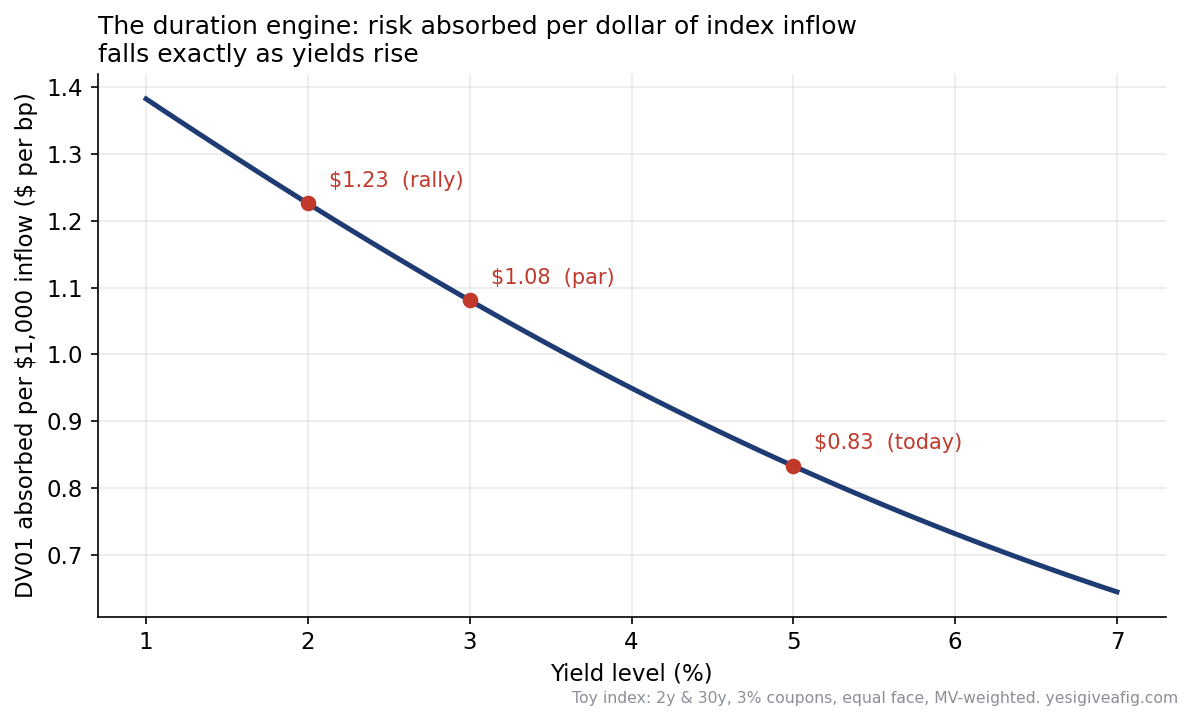
Run the arithmetic on a toy index holding a 2-year and a 30-year bond in equal amounts, both with 3% coupons. At par, $1,000 of new money takes on about $1.08 of DV01. Let yields fall to 2%: the long bond rallies to 122 cents on the dollar, its weight in the index swells past half, its own risk extends, and the same $1,000 now absorbs $1.23 — the index takes on the most interest-rate risk at the top of the market. Push yields to 5% and the long bond trades at 69 cents: its weight and risk both shrink, and $1,000 absorbs $0.83 — roughly a third less than at the peak, at precisely the moment long bonds are cheapest and the government most needs buyers.
The real ladder is more extreme than the toy. Take the 1.25% Treasuries of 2050: they trade near 47 cents on the dollar, and the discount does something underappreciated to risk — with almost no coupon flow, the bond’s value concentrates in the distant principal payment, pushing its modified duration to roughly eighteen on only twenty-four years of remaining life. A 47-cent dollar behaving like a zero, carrying about $1,800 of DV01 per million dollars of market value: the densest interest-rate risk per dollar in the market, held at the smallest index weight of its life. Now price every outstanding 30-year issue this way — actual coupons, actual issuance sizes, including the hole where the suspended auctions of 2002–2005 should be — and the whole sleeve confesses.
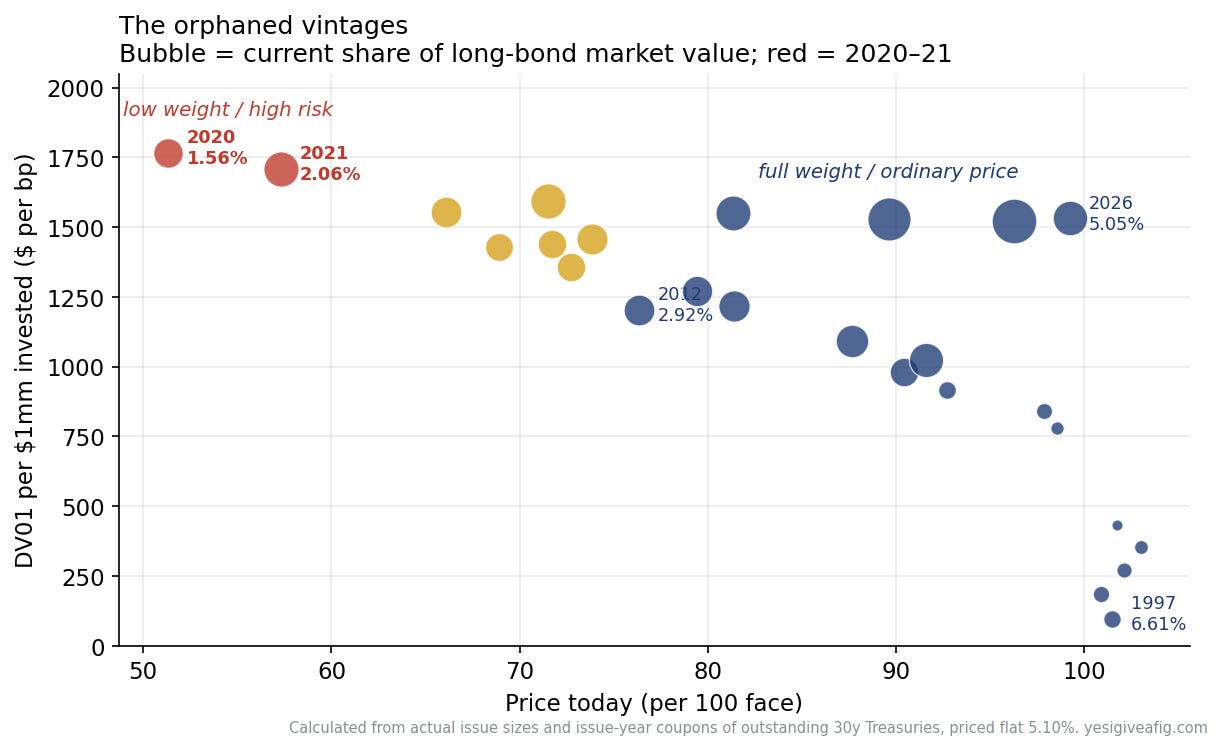
The red dots are QE’s orphans. Washington issued extraordinary quantities of thirty-year paper at coupons below 2%, and then the rate regime changed underneath them. Silicon Valley Bank was the most famous casualty of the same low-coupon regime, but hardly the only one. Prices collapsed, shrinking their index weights, while the tiny coupons left nearly all the cash flow in the distant principal payment. There they sit in the upper-left corner: little market value, dense risk.
The chart also kills a tempting shortcut: cheap does not mean dense. The 1997 issue sits near par with almost no risk per dollar left in it; the 2026 issue is nearly as dense as the orphans at full price and full weight. Becoming an orphan took all three: a tiny coupon, huge issuance, and a regime change after the fact.
The long-bond sleeve is a barbell. At one end sit the 2024–2026 issues: near par, full weight, ordinary risk. At the other sits the QE decade. The two COVID years stand apart: half a trillion dollars of face issued in 2020 and 2021, at coupons of 1.56% and 2.06%, now marked near 55 cents and carrying roughly $490 million of DV01 per basis point in barely ten percent of the sleeve’s market weight.
Add up the discount cluster. Bonds below 75 cents are about 35% of market value but 41% of the risk. The QE-era vintages are nearly half the sleeve’s risk in well under half its weight. That is the problem for the index: the rate shock crushed their market-value weight, but their tiny coupons left them among the most duration-dense bonds in the sleeve. The orphans now contribute roughly half as much market value per dollar of face as they did at issuance.
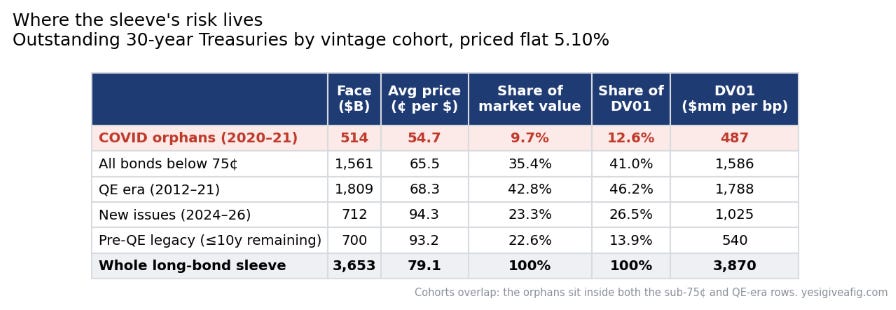
Two offsets soften the effect. New issues enter near par, and mortgages lengthen in selloffs. But neither changes the direction. Keep the barbell in mind; it returns later in the mortgage market discussion.
Now contrast the buyer this machine replaced. The Japanese insurer also bought without checking the price — but its demand was anchored to promises it had made, and it endured for exactly as long as the promises did. The index makes no promises. The insurer had liabilities. The index has weights — and the weights say less precisely when the market needs more.
